

Gizapolitan Connects Giza’s Monuments to Its Everyday Familiar Chaos
Gizapolitan captures the city beyond its monuments, weaving ancient references with the colours, chaos, and craft of everyday life.

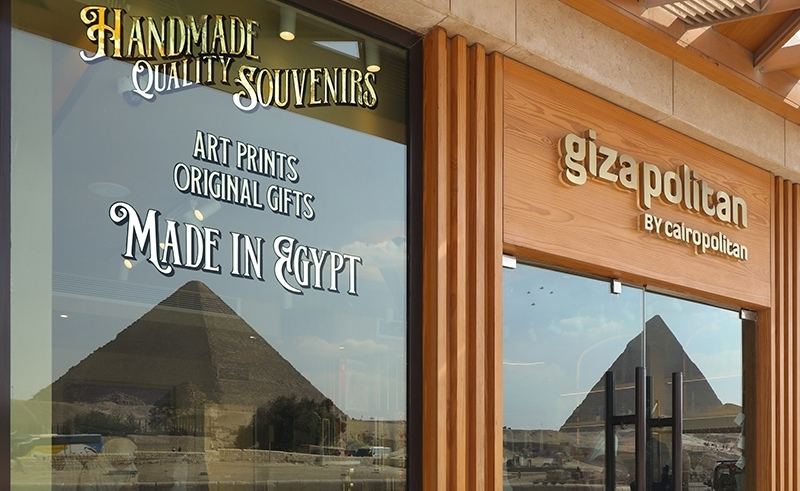
Cairopolitan has long been our go-to when we want to wrap Cairo up and take it with us. Whether for a friend visiting for the first time or someone far away who misses its noise, humour, and contradictions. It’s the place to find fragments of Cairene life turned into objects, souvenirs, and interiors that nod to quiet inside jokes. Now, that same impulse has found its way west.
Set against the edge of the Giza Plateau, Gizapolitan continues Cairopolitan’s long-running project of branding the city through itself. After Garden City, and within reach of the familiar epicentre of Cairo’s urban pulse Downtown, Giza felt like the natural next stop, and the pull was constant. The Pyramids were never meant to be a backdrop for the new spot, but part of the story waiting to be collected.
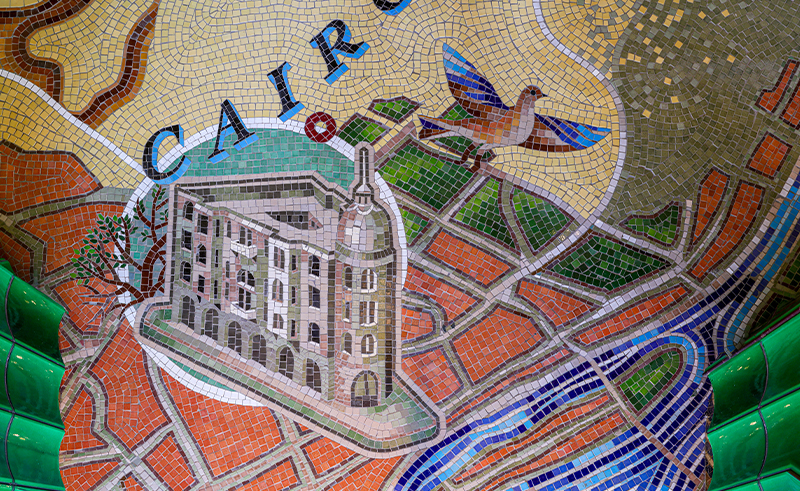
The concept was born from the same duality that defines Cairo and Giza: heritage and chaos, symbolism and everyday life. Architect and designer Nelly El Sharkawy and product designer Ahmed Hefnawy approached the project as a dialogue between both worlds. “We wanted to interpret Giza as a living city,” Nelly explains. “Something that draws from ancient Egypt but speaks the language of the streets today.”
Since their audience is as layered as their references; tourists, expats, Egyptians abroad who recognize Giza beyond its postcards. The launch captured that in-between space, where motifs of ancient Egypt meet the microbuses, the street signage, and the textures of local life. The challenge from day one was avoiding the expected. “We agreed early on that we wouldn’t fall into the trap of the pharaonic cliché,” says Nelly. “Ancient Egypt wasn’t beige. It was full of blue, green, emerald, and coral. There’s no reason to strip that richness away.”
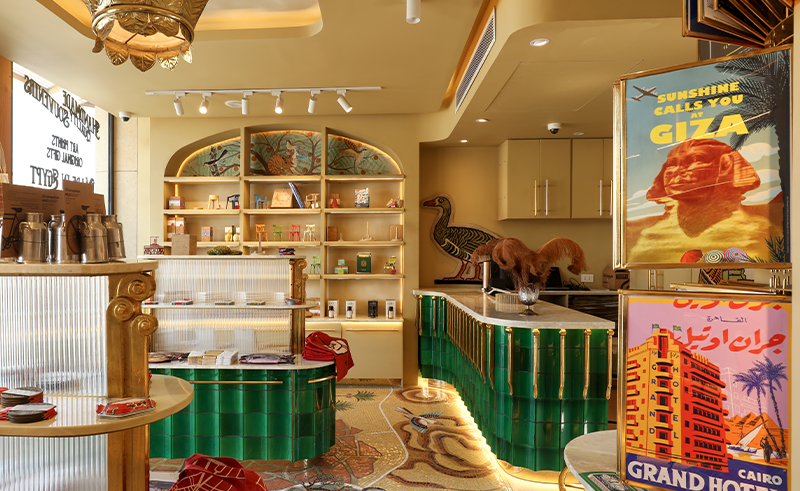
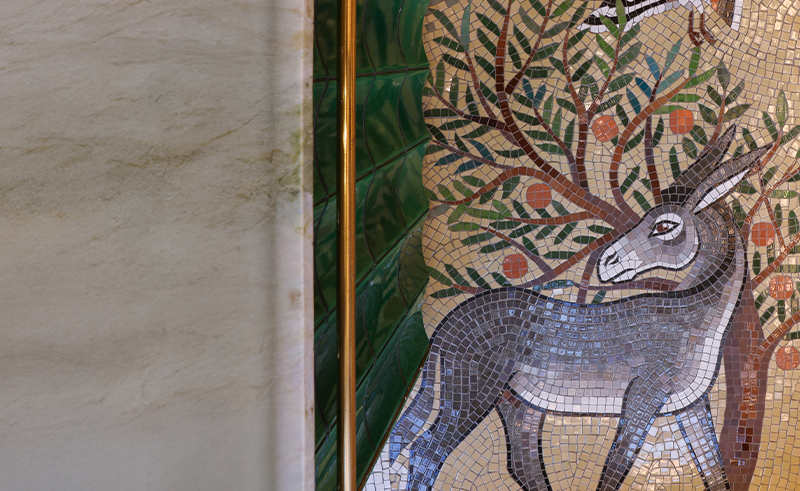
That expanded palette runs through the entire interior, connecting three central design gestures: the mosaic floor, the sculptural counter, and the monumental brass light unit. Each was treated as an artwork of its own, built through countless rounds of testing, simulation, and fabrication.
The mosaic, placed across the main floor, maps Egypt’s landmarks. Designing it required sensitivity: how to represent cultural icons without creating discomfort around the idea of stepping over sacred sites. “We went through several iterations to find the right balance,” says Hefnawy. “Each piece was simulated digitally before being placed. It’s a map, but it’s also a memory you walk on.”
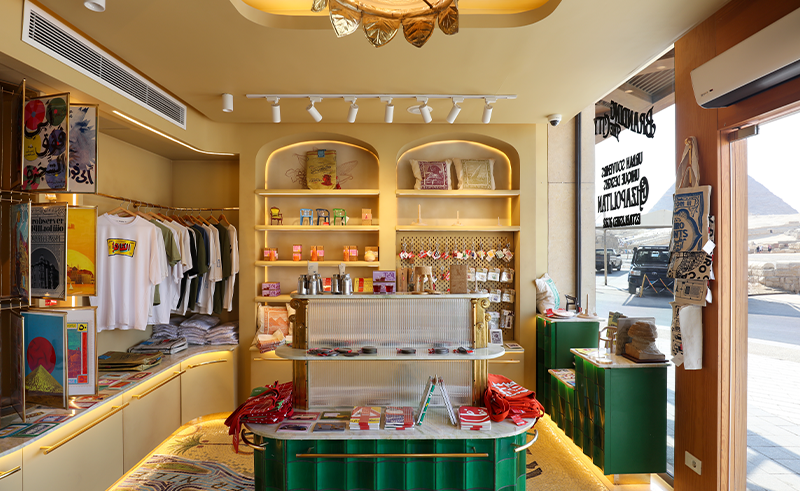
The counter on the other hand is an equation of geometry and craft. Originally imagined in ceramic, it proved too complex and costly to mold. “We tried everything, even asking my old math teacher to help calculate the curvature,” Nelly recalls, laughing. “In the end, we created it in wood but treated every rectangle individually, painting and glazing each piece until it looked like ceramic.” The result is seamless, tactile, and unmistakably handmade. “Everything was produced in our in-house workshop,” Hefnawy adds. “It’s about precision, but it’s also about presence, every surface carries the touch of the people who made it.”
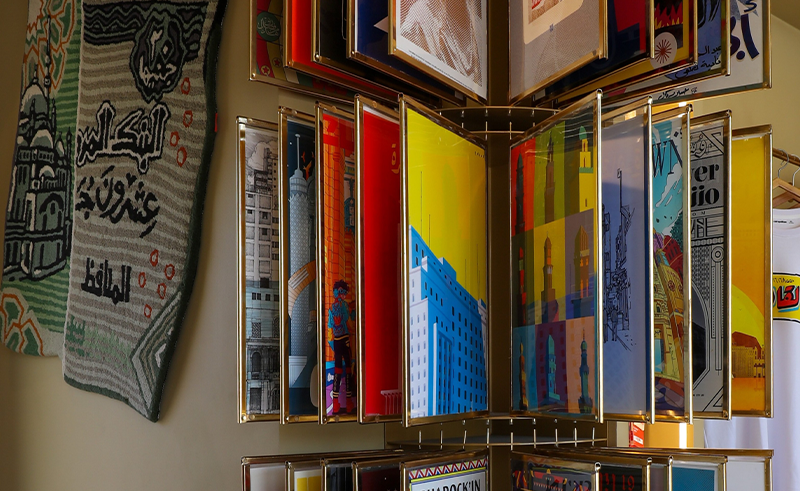
Above the counter, a sculptural brass light hangs low, its palm-leaf forms casting a quiet reference to temple crowns. It anchors the room in scale, while nodding to ancient forms reimagined for a new context. The walls, meanwhile, carry a deliberate patina of a soft dirt effect that ages the space intentionally. “We wanted it to feel lived-in, not staged,” says Nelly. “Like something that’s always been there, rediscovered.”
Through it all, brand and space remain inseparable. With Orascom’s support in shaping the retail district near the Pyramids, Gizapolitan’s official opening aligns with the launch of the Grand Egyptian Museum, bridging two eras of Egyptian storytelling.
- Previous Article Desert X Exhibition Will Inhabit AlUla Valleys From Jan 16 to Feb 28
- Next Article The Ancestral Resilience of Omar El Farouk’s Fayoum Home