

The Lost Legacy of Egypt’s Master Set Designer Maher Abdel Nour
Film sets were essentially treated like theatre sets - two-dimensional and static - before Maher Abdel Nour came into the picture.

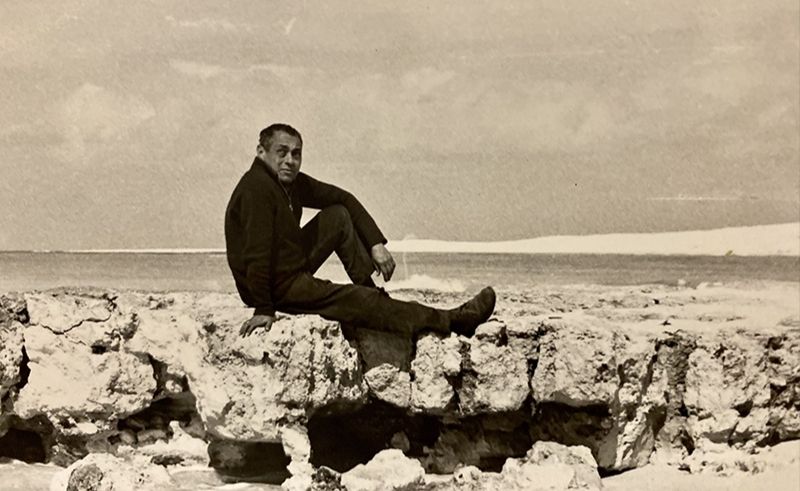
"His name led nowhere. The man who single-handedly built the sets of almost four hundred Egyptian films has only one grainy picture from his final days on the internet, no books to his name, and a few scattered fragments of interviews buried in old magazines," says Heba Elsaghier, a researcher who dedicated a year of her life to chasing the traces of Maher Abdel Nour, hoping to find something, anything, that would lead to him.
An architect and set designer, Maher Abdel Nour worked in Egyptian cinema from the early 1950s until his last breath in the mid-1990s. Many of his films are listed among Egypt’s hundred best, yet despite the legacy he left as a foundation for future generations to build on, he remained criminally underrepresented. Some say this was due to personal qualms with him—as he was known for being a “dictator” on set who refused to have another mind contributing to his films. Others attribute this to the false belief that films belong solely to their directors, without consideration for the many other factors that bring them to life. Whichever is the case, Elsaghier was determined to bring Abdel Nour's work to light.
Before becoming a researcher and a lecturer at the Faculty of Media and Journalism, Heba Elsaghier was a film enthusiast, a “cinephile.” As a child, she would come home from school, throw her bag aside, and run to the television in her living room to watch whatever film was playing that day.
When watching Egyptian cinema classics, most people are impressed by how elegantly the characters dressed or how poetically they spoke. Not Elsaghier. She was infatuated with the houses and décor in these films; the unusual pieces of furniture, modular chairs and couches and oddly shaped chandeliers and lighting units. “Why doesn’t my house look like this?” she asked herself one day while watching Soaad Hosny’s ‘Sagheera Ala Elhob’, specifically the scene in which Roushdy Abaza presses a button and a bed emerges from the wall.
Years passed, yet Elsaghier’s fascination with film sets in Egyptian cinema—especially films from the 1950s to the 1970s—never ceased. On the contrary, it deepened when she discovered that most of these films were designed by the same man, Maher Abdel Nour. What began as a research paper on his work—undertaken largely to satisfy her younger self—eventually grew into a book that stands as the only comprehensive documentation of Abdel Nour's life and work: 'The Modern Taste in the Furniture and Décor of Egyptian Films'.-ca9728d7-14eb-4c93-b6fc-2b87844673bf.png) In her book, Elsaghier draws a map of the history of set design in Egyptian cinema, placing the three decades from the 1950s to the 1970s at its centre. She explores how set designers of this era—especially Abdel Nour's—were deeply influenced by early 20th-century political movements, using design as a revolt against classical styles…
In her book, Elsaghier draws a map of the history of set design in Egyptian cinema, placing the three decades from the 1950s to the 1970s at its centre. She explores how set designers of this era—especially Abdel Nour's—were deeply influenced by early 20th-century political movements, using design as a revolt against classical styles…
Set Designs Before Maher Abdel Nour
“Classical styles were associated with the monarchy,” she explains. “They were protesting the monarchy and everything it represented: conservatism, excess, the use of more than one needs for the sake of showing off, and the privileges reserved for the elite—the modern style movement is socialist at its core.”
She pauses for a second then shrugs, as if recalling something funny. “It’s ironic how minimalism and modern styles are now associated with wealth, the very ‘elite’ they once stood against.”
Additionally, set design was largely confined to fine arts graduates, who prioritised aesthetics over practicality and realism. Film sets were essentially treated like theatre sets—two-dimensional and static. That changed when Abdel Nour introduced movable walls and columns, a simple idea but groundbreaking at the time; it elevated nearly every aspect of filmmaking, from allowing greater control over lighting to bringing a level of realism that had not been possible before.
Set Designs by Maher Abdel Nour (1950-1979)
“Those three decades were truly revolutionary,” Elsaghier says, a spark in her eyes visible even from across the room. “The furniture and designs were far more modern and sophisticated than what I was used to seeing in our homes… even more so than much of what we have today.”
In the mid-1950s, after the king was overthrown and the English occupation left, a new social class started to take shape in Egypt —the national bourgeoisie.
“So this national bourgeoisie class… they were wealthy, and for the longest time wealth had been associated with classical, monarchical styles,” says Elsaghier. “But this class was also new to society. You can’t pair it with old monarchical aesthetics like many used to—and still do—because it doesn’t make sense. Abdel Nour was intelligent enough to realise that. So he created a whole new style for them; something fresh and modern that expressed wealth in its own way, just like them.”
'Alemouny El Hob' (1956)
In 'Alemouny El Hob' (1956), this new social class was represented by Iman’s family. Their house, which was designed by Maher Abdel Nour, mirrored their characteristics. The Salterini chairs made of malleable iron, the Sputnik chandelier taking the shape of sunrays, the kitchen that was open to the living room which was introduced to the Egyptian society for the first time (later known as American kitchen), the spacious empty areas in the house, the openness of the house where different units are separated by a few steps of stairs instead of walls. All of these unfamiliar choices were not haphazard, Abdel Nourwas building an identity from scratch for this class, something that was new, unusual, and reflective of who they were and expressed their open-mindedness.-addf47e8-c517-4d22-abc8-beace002cd9b.png)
'Sagheera Ala El Hob' (1966)
“That was the film that started it all; that’s the film I fell in love with and led to the birth of this book.” Says Elsaghier.
In 1966 when building the set of 'Sagheera Ala Elhob', Abdel Nour felt an interest to explore the intersection between art and technology. Souad Hosny’s room is seemingly empty, until Roushdy Abaza kicks the wall and a couch drops, pushes a button and a bed comes out of the wall, opens the wardrobe and a dresser mirror reveals. This was all new to Egyptian society, groundbreaking even. After the film came out, Abdel Nour’s neighbours reached out to him to build them similar beds using the machine he imported from Germany specifically for it.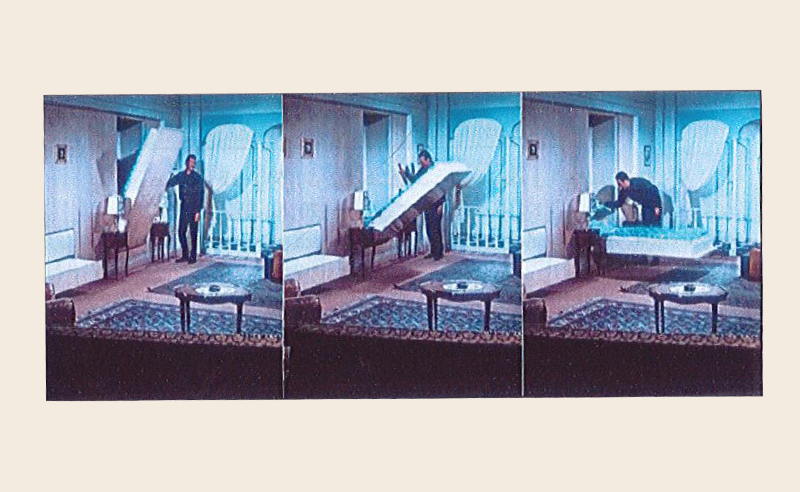 'El Mar’a El Okhra' (1978)
After the October 6 War, Anwar Sadat opened up the Egyptian economy to private investment. Most film plots during this era, directly or indirectly, revolved around this new policy—and 'El Mar’a El Okhra' was no exception.
In 'El Mar’a El Okhra', Nour Elsherif plays a money-hungry man determined to get rich at any cost—even if that means marrying someone he does not love simply for her wealth. Abdel Nour conveyed this idea through the his bureau, which strictly followed the modern taste for abstraction, evoking strategic thinking and emotional detachment. The Ukrainian-inspired Verner Panton monochromatic orange-red chairs, the two abstract paintings on the wall, the absence of ornaments, and the stark white walls all served the plot and translated Nour Elsherif’s ideology and values through his surroundings.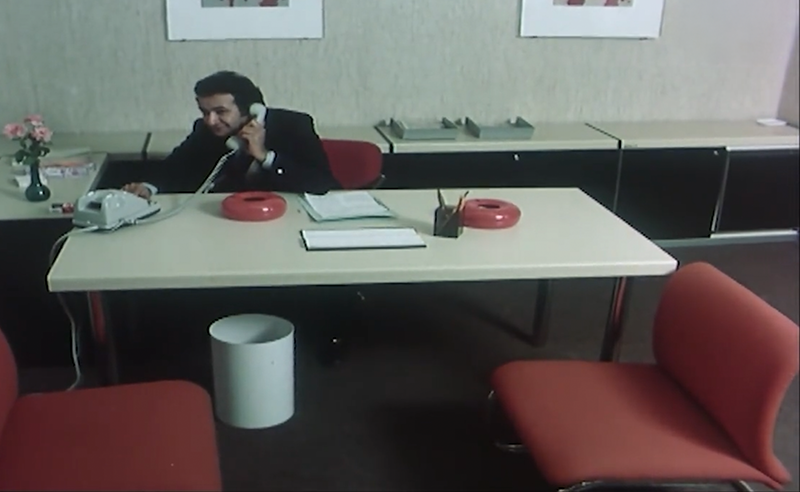 Set Design Beyond Maher Abdel Nour
Throughout the 1950s and 1960s, Abdel Nour stood alone when it came to modern set design. While everyone else remained attached to classical styles, Abdel Nour paved the way for a new era of films—one that broke free from the old conventions. In his sets, furniture, colours, and lighting units went beyond mere aesthetics and became part of the plot, highlighting the characters’ traits and revealing their motives.
By the 1970s, a new generation had emerged. Set designers with architectural backgrounds like Abdel Nour were gradually replaced by graduates of the Higher Institute of Cinema, which had opened in the late fifties. This new generation strictly applied the principles of modern taste, completely abandoning the old. Furniture followed the Nordic style that had dominated the world over the previous two centuries, lighting units drew from Italian designs, and inflatable furniture made its debut. This resulted in the birth of a cinematic language in which the story of an entire film could be read through its decor.
This is bluntly obvious in the film 'Awham El Hob' (1970).
Onsi Abu Seif, who had graduated from the Higher Institute of Cinema just three years earlier, was telling a love story growing cold, a couple drifting apart and a relationship reaching a dead end, and his set mirrored that distance. The colour palette ranged from white to pale blue, the abstract paintings barely conveyed any emotion, and the furniture was sparse and widely spaced. One look at the house’s set and it is clear that whoever lives here can never be happy or in love.-fa3731c6-ffe3-4b7f-b727-aa1ccae179fb.png) The 21st Century’s Set Designs
The 21st Century’s Set Designs
With resources now almost equally accessible to everyone, set designers have increasingly relied on dazzling sets to stand out. But this has created a new challenge: how can they apply the rules of modern taste to portray the middle class in a way that is both distinctive and realistic?
“My favourite 21st-century film in this regard is 'Lamo’akhza',” says Elsaghier. “Here, we have a film that realistically embodied the middle class through modern taste.”
In 'Lamo’akhza' (2014), Hany’s family is middle class by every definition. The mother is an artist; the father is a banker who earns well, yet still has to rely on loans to afford a sophisticated education for their only son. They are educated and rich but not wealthy—and after the father’s passing, grief reshapes the household. Hind Heidar, the film’s set designer, translated this into the family’s home.
The colour palette leans toward cold tones, reflecting mourning. The house is modest in size, yet carefully organised. Ornamentation is avoided and replaced instead with geometric decorative elements. The furniture is modern but not overly sophisticated, and malleable steel gives way to wood as it is more affordable and common among the middle class. It is not extravagant but it reflects culture and taste.-6da4d507-4d59-444f-b19d-dcaf4288b7db.png) Maher Abdel Nour may have never received the recognition he deserved. He was not an exception in an industry that often narrows cinema down to its actors and directors, overlooking the architects who quite literally build the worlds of these films. But history has a way of circling back. Through 'The Modern Taste in the Furniture and Décor of Egyptian Films,' she restores a missing chapter of Egyptian cinema, placing Abdel Nour back where he always belonged - at its foundation.
Maher Abdel Nour may have never received the recognition he deserved. He was not an exception in an industry that often narrows cinema down to its actors and directors, overlooking the architects who quite literally build the worlds of these films. But history has a way of circling back. Through 'The Modern Taste in the Furniture and Décor of Egyptian Films,' she restores a missing chapter of Egyptian cinema, placing Abdel Nour back where he always belonged - at its foundation.
The book is available at El Ain Publishing House in Abdeen and online via the Abjjad application.
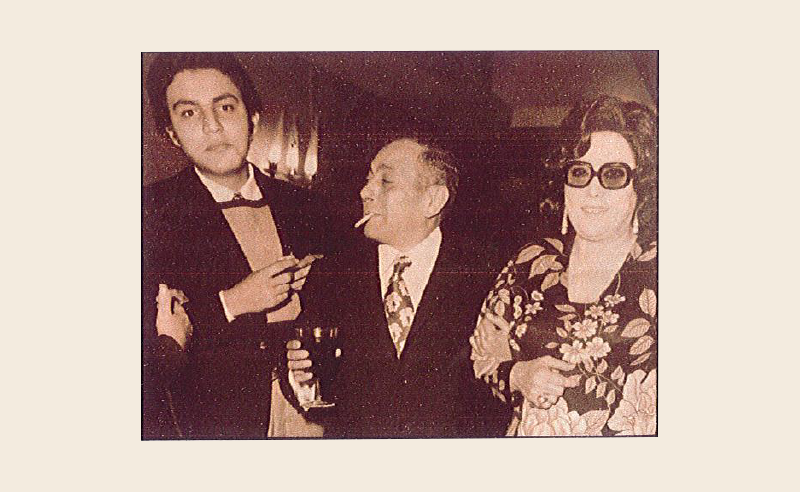
All images of Maher Abdelnour are courtesy of Heba Elsaghier’s book 'Modern Taste in the Furniture and Décor in Egyptian Films.'
- Previous Article May Elghandour's Love Story With Light, Colour & Glass
- Next Article The Ancestral Resilience of Omar El Farouk’s Fayoum Home