

Cairo Design Week’s Makerspace Brings Student Design to Heliopolis
Makerspace gives emerging designers space to show their work, test ideas and meet the people who could help take their projects beyond university.

A graduation project can become the beginning of a professional career at Cairo Design Week. Makerspace gives student work room to move beyond the classroom, alongside workshops and experiments showing how ideas become objects.
Makerspace returns to Showland Merryland in Heliopolis for the 2026 edition, as Cairo Design Week opens its Heliopolis district on November 20.
Created by Creative Districts in collaboration with Studio 34 and curated by Base Studio Cairo, Makerspace brings together university exhibitions, workshops and panel discussions.
Dedicated spaces also bring in Fab Lab, architectural platform WeAreDESCO and multidisciplinary design studio Moshtarak.
The initiative forms part of Studio 34's longer-term ambition. “We want to bring universities from around the world into the exhibition and give their students a place to showcase their work,” says Ahmad Maher, co-founder and managing director of Base Studio Cairo and creative director and managing partner of Studio 34.
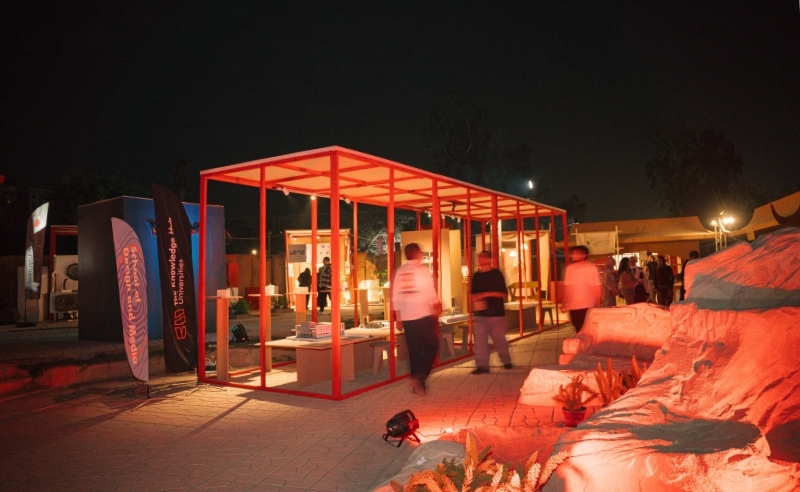
-30ad8c4b-1f3b-4582-8944-973033e6e685.jpg) The installation carries forward the metamorphosis concept explored in 2025. Twelve stages trace a sequence from origin and awakening to fragmentation, reassembly and renewal.
Maher describes the concept as “the development of the process, starting from origin, awakening and shedding”.
Frames from the previous installation have been repositioned to form this year’s layout. Perforated panels offer glimpses into neighbouring displays, while colour coding identifies participating universities.
The university exhibition area presents student projects and design research, while a separate section turns attention to what happens before the final presentation.
The aim is to make room for the thinking and development behind the finished work.
-eefa4d51-17f9-4693-a985-41fcaa70041c.jpg) “This is a platform for the students,” Maher says.
The participating institutions curate their own displays, highlighting the stages through which students develop their projects.
Cairo’s Workshop, founded by architect Yahya El Hosafy, starts its learning process with a set quantity of natural wood, hand tools and a project of the participant’s choice.
Its Zero to Hero course teaches the fundamentals of woodworking, from dimensions and structure to function and material limitations.
Makerspace turns that approach into a live experiment with two teams: one made up of design students and another of participants from other disciplines.
Work by previous trainees and established designers offers further points of comparison, showing how different levels of experience translate into objects.
Fab Lab takes the journey from idea to object in a more technical direction. 3D printers, laser-cut models, electronic components and prototyping tools demonstrate the possibilities of digital fabrication.
-0314e7e9-dc7c-49d7-bcde-5f7fd702d235.jpg)
A workshop covers 3D printing processes, materials and the design requirements of printable components. A panel discussion considers how artificial intelligence can support the path from design to production.
WeAreDESCO focuses on what happens after graduation.
Its competition takes architectural projects beyond the university studio, connecting emerging designers with regional jurors and firms, with potential opportunities for mentorship, portfolio reviews and internships.
Moshtarak opens a door onto work that usually stays behind the scenes.
Its presentation, The Archive, gathers more than 200 concepts, prototypes, experiments and products across furniture, footwear, jewellery, technology, kitchenware, accessories and industrial design. Some have yet to reach production.
Seen together, they show the range of directions a design studio can explore before an idea becomes a finished piece.