

How a Blast-Damaged Bank From 1935 Became Beirut’s Most Artful Hotel
Two architect brothers staked their family’s name on a bombed-out heritage building. A hundred paintings and one failed menu later, Maison Dada might be Beirut’s most personal hotel.

Order lunch from one o'clock on the roof of Maison Dada, an art-filled boutique hotel above Gemmayzeh, and Beirut gives you an hour it rarely shows strangers. Generators humming below, a stray cat stretched along a balustrade two roofs over as the city carries on, dented, loud, and far too proud to apologise for either. Le D, the rooftop restaurant of the maison, only began serving by daylight this October, after a year of candlelit evenings and the hush that drops once the traffic thins.
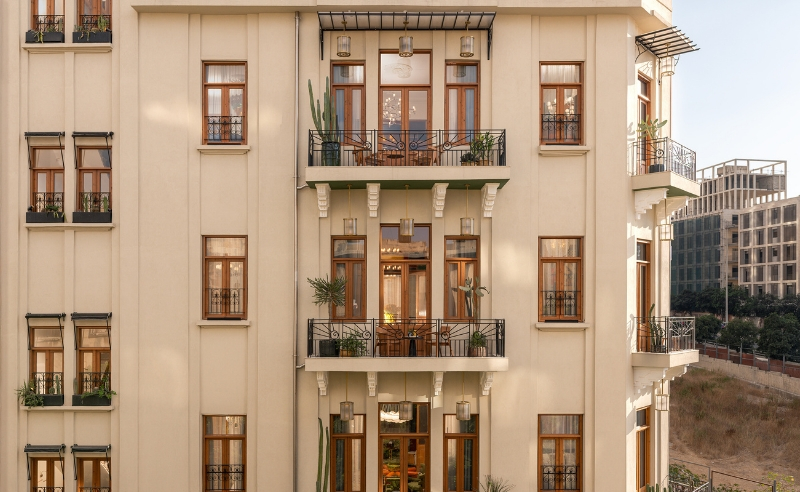
Three floors below, behind French windows that have outlasted a mandate, a civil war and the blast that flattened half the street outside, brothers Marc and Mario El Dada have spent the past year and a half working out what to do with a building that has already lived four or five lives and happens to bear their family name on the deed.
The brothers have worked in architecture and design since 2004, when they left Beirut for Doha and opened a firm that has since worked on more than sixty projects across Qatar, including commissions for the country's royal family. None of that professional distance survives inside this particular building, which they call, simply, a love project.
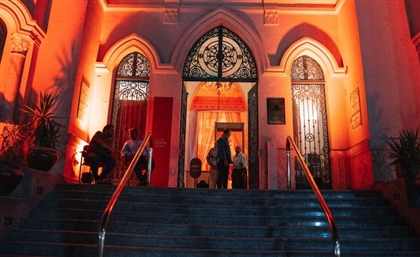
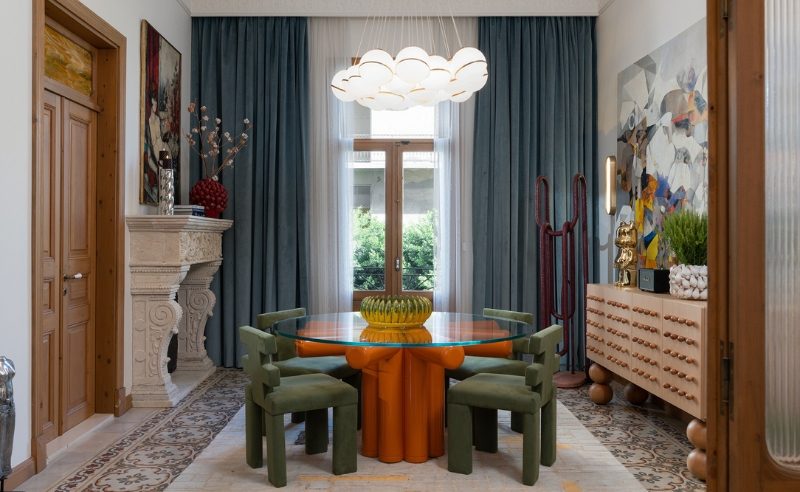 "It was built in 1935, under the French mandate so it’s a heritage building and it's owned by our parents," Marc says, tracing its history through the golden years, the war that started almost on this corner in 1975, and, finally, the 2020 Beirut port explosion, which blew out whatever glass the decades hadn't already taken and sent the bank that was renting the ground floor packing not long after.
"You leave a building alone, without maintenance, and it falls down," he says. "Even a human needs maintenance to survive."
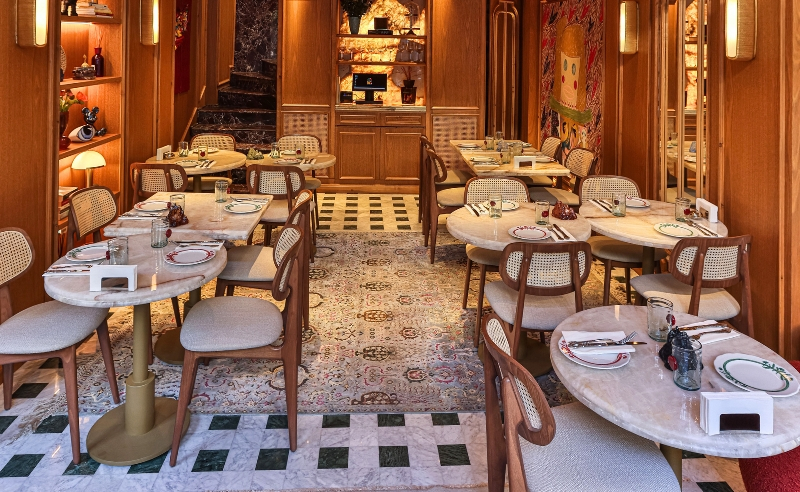
The brothers considered leasing the property to an embassy, renting it out to tenants or leaving it as it was. None offered what they wanted: a reason for people to return. Instead, they turned the ground floor into a bistro, the upper floors into three hotel suites, and the rooftop into a restaurant that now welcomes diners by day as well as night. “We wanted people to come under this roof, meet for coffee, for drinks, socialise,” Marc explains.
Restoring the building meant working within the limits of its heritage designation. The floors are the original 1935 tiles, poured and coloured by hand, one at a time, in a technique barely anyone still practices. It’s closer, as Marc puts it, "to a sculpture, but a floor sculpture," which makes it absurdly expensive to repair and even more absurd to replace.
The woodwork took two months under the hands of Zahia, the craftswoman who restored every door and join, peeling back decades of paint to find out what colour the building used to be. Blue in one era. Pink in another. Each layer belonged to someone who lived there before the explosion gave them a reason to leave. "People built this by hand, not machines," Marc says. “That’s why we kept the original wood from 1935 and tried to bring it as close as possible to the original."
Their design team, pulled from Tunisia, Egypt and Lebanon, spent weeks researching the exact gold and blue of Beirut's golden age, a palette with nothing in common with the beige most new builds default to. "They fell in love with it," he says. "They wanted to know the colour of the hinges."
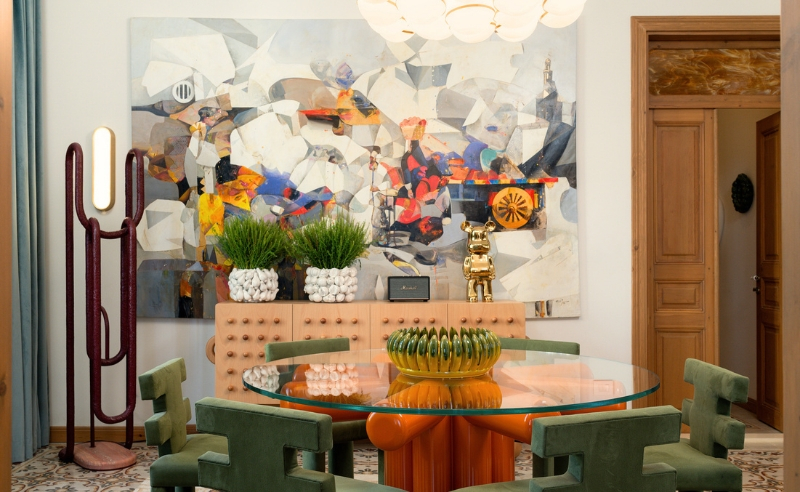
 Then there was the art, a collection that had been accumulating long before Maison Dada existed. "Wherever my brother and I travel, we don't buy jewellery or clothes. We acquire paintings. I'll say, ‘I want this one,’ and he'll say, ‘Let's think about it’, and I'll say ‘No, I want this painting’."
Their mother spent years asking them not to hang them and ruin her interiors. Two decades on, the brothers realised they'd collected more than a hundred works without ever deciding to become collectors, and Maison Dada became the first place both large enough and finally theirs enough to hang them properly.
The question then became how to make the rooms work around the art. Heritage restrictions meant the building’s apartments could not be subdivided, so the brothers converted them into three suites, each retaining the proportions and feel of a Lebanese home. "You're not staying in a gallery, you're staying in an authentic Lebanese apartment where you can experience art.”
The suites include two bedrooms, a dining room, a salon and a fully equipped kitchen, alongside concierge service, housekeeping and breakfast. The House of Love, lowest down, runs through natural wood and soft greens and blues. Above it, The House of Stories turns pinker and warmer, before the top suite, The House of the Artist, lands somewhere close to full daylight: pale, yellow at the edges, blue further out. "Close to the sun" is how Marc puts it.
The food took its own kind of convincing. Marc wrote the brief for the bistro's menu himself and handed his executive chef instructions precise enough to rival a construction drawing. The first attempt failed. So did the second. "I got stressed, it was my first time in hospitality," he says. "How did we fail twice?" He solved it by sketching how he wanted every plate to look before handing the brief back a third time. It worked.
 The building opened, on purpose, on Valentine’s Day amid an actively violated ceasefire, with foreign troops still on Lebanese soil and staff briefed to call it a soft launch in case anyone wanted to complain. By eight that evening it was fully booked, chaos in the kitchen included, and has stayed more or less fully booked ever since. Ask Marc what he actually took from the whole experience and the architecture talk briefly drops away. "Hospitality needs to be generous," he says. "It's about the people, not only a beautiful plate."
Beirut, for now, is still the whole plan, though perhaps not for much longer. Offers to expand have been landing since the opening, and the brothers are already eyeing a second site in the mountains, twenty minutes out, built around healing and hospitality. Their mother is undergoing cancer treatment, and the project is brewing directly out of that: nursing rooms alongside the suites, a doctor on call, an IV drip if you need one.
"We want to build this for her," he says, “So people can come, enjoy the hospitality, and also recover."
But whatever comes next, Maison Dada began as something the brothers wanted to give back to Beirut. "As much as we love Beirut, we're offering this project to Beirut, because the city needs it, because it deserves admiration. It's beautiful."
For them, Maison Dada is also an argument for continuing to build, even when the circumstances seem to argue against it. “Opening anything during a war is genuinely difficult,” Marc says. “And I really hope the next generation takes our story as a push to keep going, working, building. To know they can still chase their dreams, even during a war.”
- Previous Article Shahira Fahmy Brings Egyptian Faience to Design Doha 2026