

Iraqi Architect Ola Znad Centres Women in Southern Iraq’s Reed Craft
Commissioned for Beyti Beytak in Doha, Souq Al Liqa turns reed craft and field research into a women-centred gathering space built with materials and makers from southern Iraq.

Iraqi architect, designer and researcher Ola Znad has spent years studying the traditional architecture of southern Iraq as a way of reconnecting with her roots.
Born in Baghdad and raised in Bahrain, Znad has been exploring the region's architectural traditions, materials and the communities whose knowledge has shaped them over generations.
Her research, which began in 2021, is quite personal. Znad has not returned to Iraq since 2003 and sees the work as a way of learning more about her birthplace and reconnecting with it.
That personal connection has developed into an ongoing body of research that she brings into practice through Studio Znad, her independent design studio. She translates it into architecture, exhibitions, furniture and objects.
 "I'm trying to make it applied research, so that it's no longer just theory, but also practice," Znad says.
One outcome of that research is Souq Al Liqa, an installation commissioned by the Art Mill Museum for Beyti Beytak: My Home is Your Home in Doha.
The installation draws on the mudhif, a traditional communal guesthouse built from reeds in the marshlands of southern Iraq and traditionally used by men to gather, share meals and receive guests.
Znad's research turned her attention to the women whose work helps make these structures possible. Their contributions include weaving al-bariyah, mats made from reed leaves that form part of the architecture, alongside other craft involved in the construction.
As Znad began speaking with women living in the marshlands, she also paid closer attention to the way they gathered in everyday life. She observed them sitting together in the afternoons with friends, each occupied with a different activity, from weaving and cooking to making bread.
"It's really clear that they don't have dedicated spaces for them to sit and gather," Znad says.
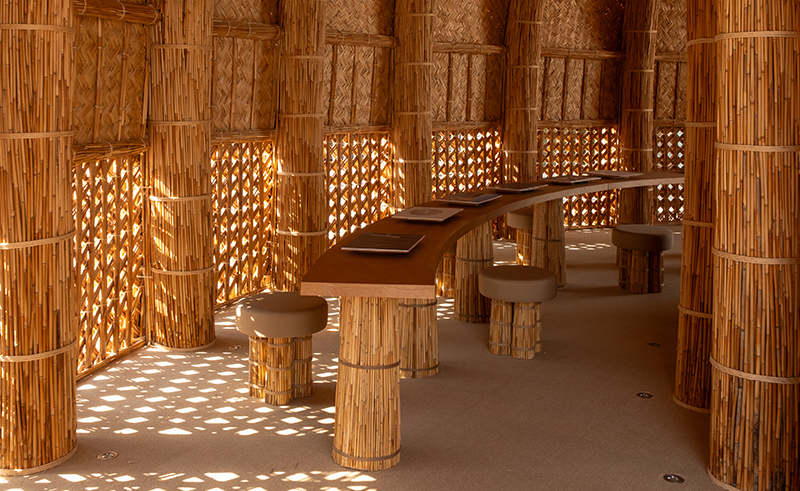
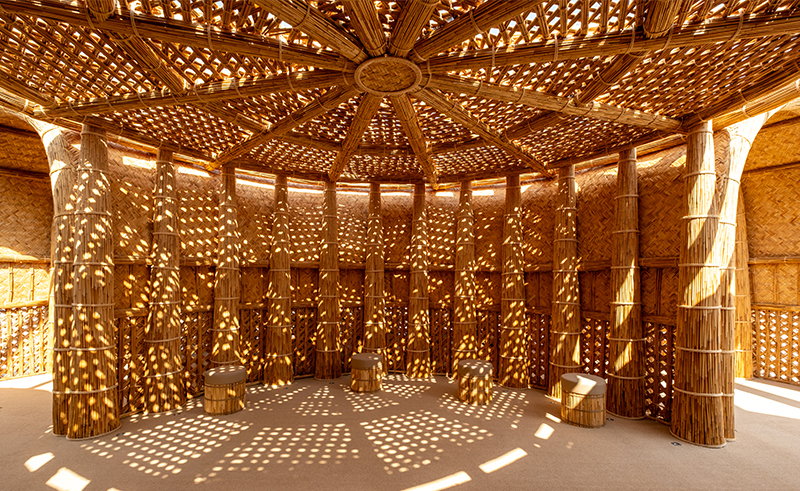
That observation informed the circular layout of Souq Al Liqa, which takes inspiration from the way the women naturally arrange themselves when gathering.
The installation gives those activities a dedicated setting while recognising the work women have long contributed to the architecture of the marshlands.
"In this iteration, it's a place for women to gather. It's called Souq Al Liqa, and this souq is for the women to honour their craft and their contribution that has been put into the construction and architecture of the marshlands," Znad says.
Souq Al Liqa retains architectural features and construction principles associated with the traditional mudhif. Znad is careful to distinguish the installation from the mudhif itself, giving it its own name, purpose and function.
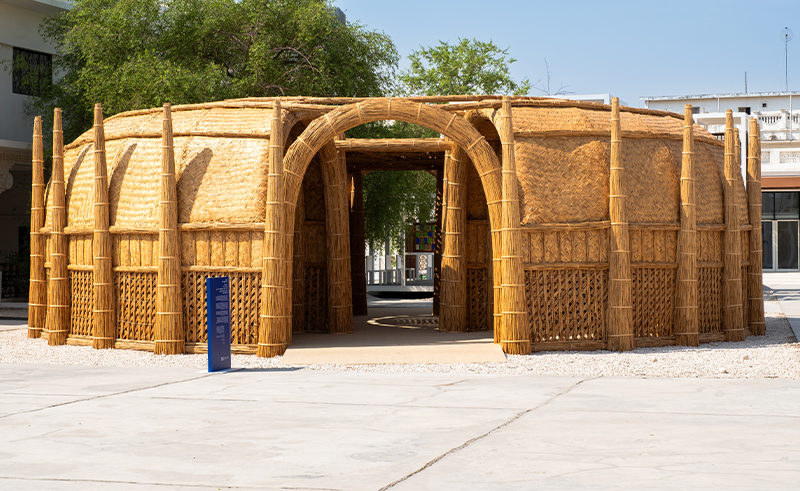 "We can't really say that we want to create Mudhifs for women, because Mudhifs were always for men. This is why the name, space and function of the typology should be different," Znad says.
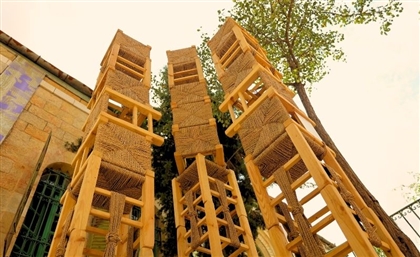
The construction draws directly from the materials and craftsmanship of southern Iraq. The installation uses qasab, the reed that grows in the marshlands, in different ways: its stalks are bundled together to form arches and structural elements, while its leaves are woven into mats.
The materials were shipped from southern Iraq, with Iraqi craftspeople and artisans carrying out the weaving and craftwork before the pieces were transported to Doha.
Znad had previously trained a team to work with these construction methods for an earlier mudhif project in Dubai. She brought the same team together again for the Doha installation.
She sees that continuity as part of a wider effort to carry traditional craft into new contexts and keep the knowledge behind it in use.
"The whole point of my practice is to inherit their craft and use it for different purposes, so that the craft doesn't die," Znad says. "I can carry this knowledge across different generations."
Part of what interests her about the mudhif is the architectural knowledge embedded in its construction. Its arches provide structural stability through geometry, allowing the buildings to reach different heights and scales depending on their owners' circumstances.
The builders learn these methods through community knowledge and practice. The resulting structures demonstrate an understanding of proportion, scale and construction that Znad finds particularly compelling.
 "They haven't studied architecture, but they are very aware of proportions, scale and all the details that we spend years studying. It's kind of intuitive," Znad says.
Keeping these construction techniques alive is also tied to the environmental future of the marshlands. The communities depend on reeds for architecture and craft, and water depletion threatens the conditions the material needs to grow.
Without water, the reeds cannot grow, making it increasingly difficult for communities to continue practising this form of architecture. Znad's research therefore also considers the material and environmental conditions that allow the knowledge to survive.
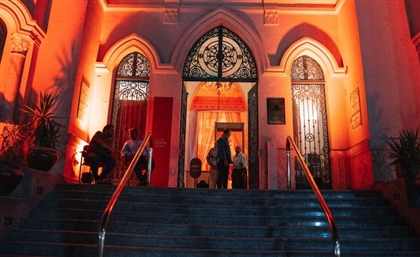
Souq Al Liqa is on view at Fahad bin Ali Palace in Doha as part of Beyti Beytak, an exhibition exploring architecture, home, hospitality and belonging. The exhibition runs through May 29, 2027, with public activities planned throughout its run.
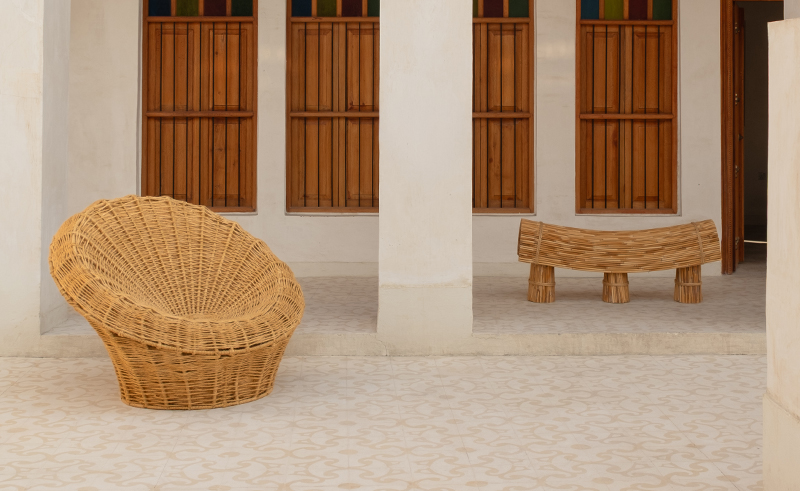
Znad's engagement with mudhif architecture continues at Design Doha Biennial 2026, which runs through January 31, 2027. Her SHABBAH furniture collection, presented as part of Arab Design Now, draws on the mudhif's arches, woven surfaces and communal rituals, translating elements of the traditional gathering space into contemporary furniture.
- Previous Article Kahhal Looms Turns the Spotlight on Egypt’s Weavers