

Egyptian Designer Adam Gobran Makes First, Designs Later
Adam Gobran melts down what doesn't work and keeps going. His folding screens for Jihan's June pop-up in Paris were his biggest commission yet, and you can buy or commission pieces directly.
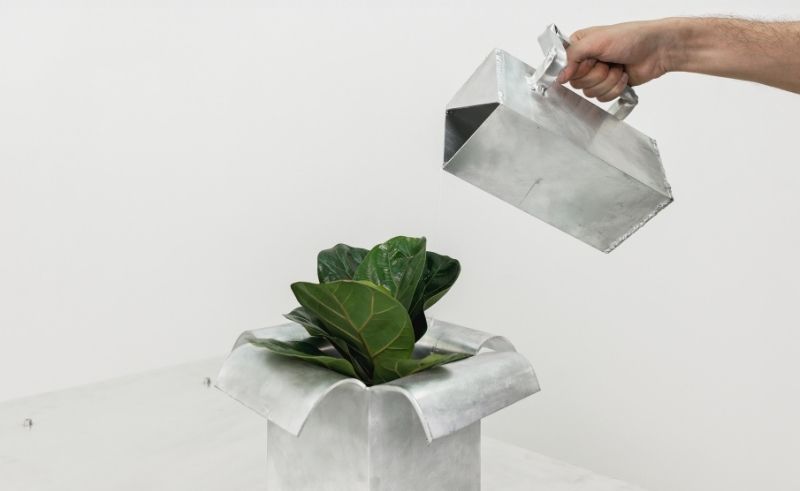
A steel tube that was supposed to become a table leg ended up as a vase. For Adam Gobran, that is not an unusual way for an object to come into being. His practice explores what he can do to a material and does not work with fixed ideas of what his finished objects should be.
Gobran has just completed his master's in Product Design at London's Royal College of Art, where his hands-on approach to making has become central to his practice. His recent work also includes a commission for Jihan, a Paris-based brand and retail space, where he designed folding screens that doubled as shelving and handrails for its June 2026 pop-up.
"It was just amazing how much trust the two founders gave me," he says. "It's definitely the biggest project that I've had to date."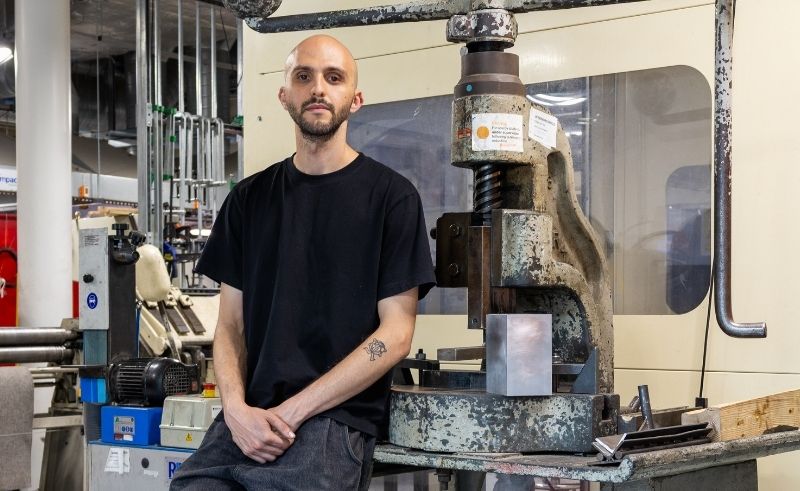 The vase came from an experiment that simply did not work as planned. Gobran was flattening a steel tube to use as a table leg, but the tube was too thick for his machine to fully flatten. Rather than abandoning it, he began looking for another use.
This is how much of Gobran's work begins. He does not sketch a finished object and then figure out how to make it. Instead, he takes small pieces of material into the workshop and sees what happens.
"I don't really say, 'I'm going to design a table,' or 'I'm going to design a chair.' I kind of do these small-scale experiments," he says. "I just have some material and a vague idea of something that I want to do to it."
Gobran describes these experiments as "structured play". He works primarily with steel and aluminium, materials that allow him to move quickly between attempts. The process is physical: bending, welding, flattening and deforming metal, then taking the results back to the studio to see which ones might become something more.
His route to making was not a conventional one. Gobran studied computer science and worked as a web designer and developer before moving into graphic design in Copenhagen. Eventually, he decided to trade the screen for the workshop and went on to study product design at London's Royal College of Art, completing his master's this year.
"I just decided that I'm going to take this risk and see if I can make things with my hands," he says. "Because it's just always something that I've been very interested in doing."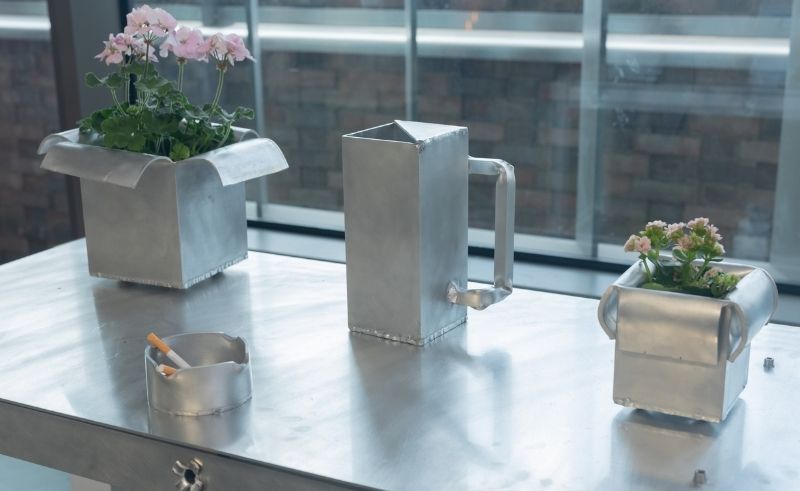 Working this way has also changed how he understands materials. A piece of metal can behave completely differently when its thickness or scale changes, something he believes is difficult to learn without actually handling it.
"The beauty of being so hands-on is that you learn these things that stay with you and become like tacit knowledge," he says. "Your intuition just knows when something's going to be horrible or if it's going to be nice."
That instinct has become particularly meaningful through his relationship with Cairo. Gobran grew up in Cairo's Maadi and left Egypt at 18. After years of feeling disconnected from the city, a recent visit to Darb Al Ahmar, a historic craft quarter in Old Cairo, gave him a different way of looking at the making traditions he had grown up around.
"I was looking at all the craftspeople there and the way that they work, and how they are so incredibly intuition-driven," he says. "You won't see a single ruler or tape measure in any of these workshops. They're really working based on what they feel."
It is an approach he now tries to bring into his own practice, where not knowing the final outcome is part of the point. It also means accepting that most experiments will never become finished pieces.
"I didn't expect that 90% of the time things are really ugly and messy," he says. "I've learned to love that ugliness and messiness that comes in between and before the final object."
Gobran melts down experiments that do not become finished objects and reuses the material, one of the reasons he loves working with metal.
When something does make it through, Gobran prefers not to hide where it came from. His materials are often ordinary stock metal, and he prefers to leave them relatively raw rather than adding finishes simply for the sake of it.
"I think there's a lot of beauty in those raw stock materials," he says. "I'll only add some treatment or colours if I feel it's absolutely necessary for the design. Otherwise, I think there's a lot of beauty already in the material."
Whether he is making a single vase or fabricating an installation, Gobran wants the process to remain legible in the finished object. He hopes people can look at a piece and understand, almost immediately, what happened to the material to make it.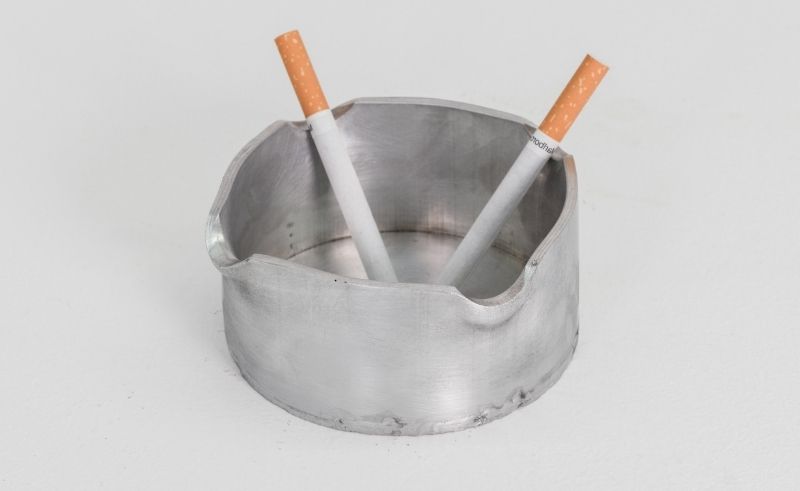 "I want them to feel a sense of connection to the object but also, hopefully, to the way that it was made," he says. "Within 10 to 15 seconds, someone can say, 'Oh, that's a tube that was flattened,' or 'Oh, that's a piece of metal that was folded over itself.'"
For Gobran, seeing how something was made can change how we value it. In a world where objects are increasingly easy to replace, he would rather we understood the things we keep.
"I think we all just need to take a longer-term view over the objects that we buy and hold, and develop more meaningful relationships with them," he says.
- Previous Article Test 2026-10-27
- Next Article This 1940s Bahraini Home Finds New Life as a Stylish Boutique Hotel