

Mayar Nasef Builds Her Debut Furniture on Egyptian Marquetry
Mayar Nasef covered each of her three side tables in 864 squares cut from one timber, turning half of them so the grain catches the light differently and a checkerboard appears from a single wood.

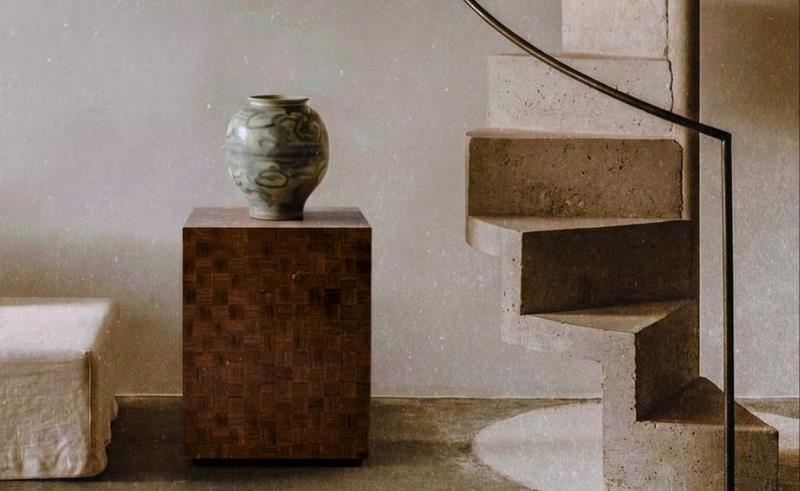
Mayar Nasef looked at what she was designing and decided it had stopped being Egyptian.
"I felt my work had become very Western," she tells SceneHome. "I wanted to reinterpret Egyptian identity into an experiential piece."
What she did not want was the shorthand. No scarabs, no hieroglyphs, no lotus flowers, nothing you would recognise from a museum gift shop. So instead of borrowing the imagery, she went to the carpentry.
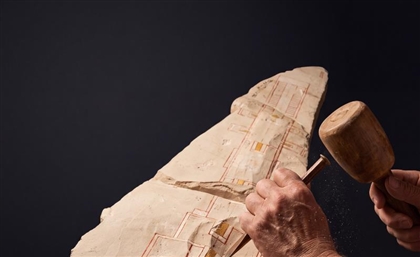
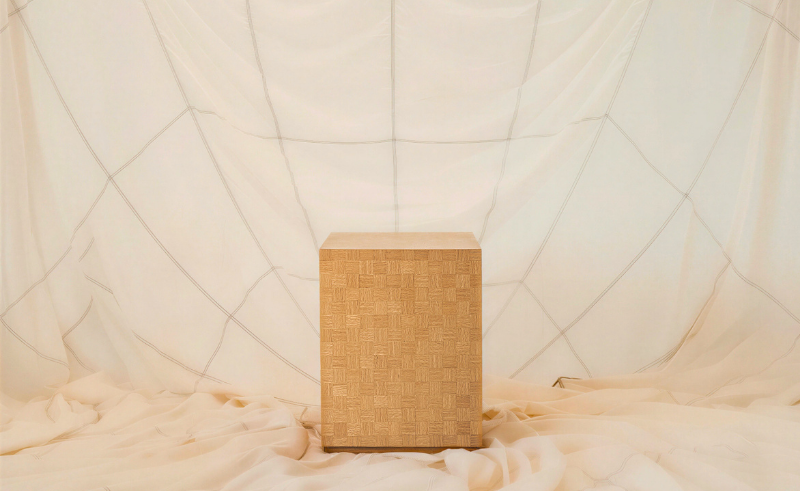 The technique she settled on is marquetry, which means building a pattern out of thin slices of wood rather than painting one on. The oldest surviving examples of it are Egyptian, from furniture found in tombs. It has been in continuous use ever since, in Cairo workshops as much as anywhere, and it usually works by setting different materials against each other: a pale wood beside a dark one, or shell, or metal.
Nasef took all of that away.
Her first collection is three side tables. Wooden cubes on low bases, about the height of a dining chair seat and a little wider than a sheet of A3 paper, the kind of thing that sits beside an armchair and holds a lamp. Each is covered on the top and all four sides in 864 small squares of wood, cut and laid down by hand.
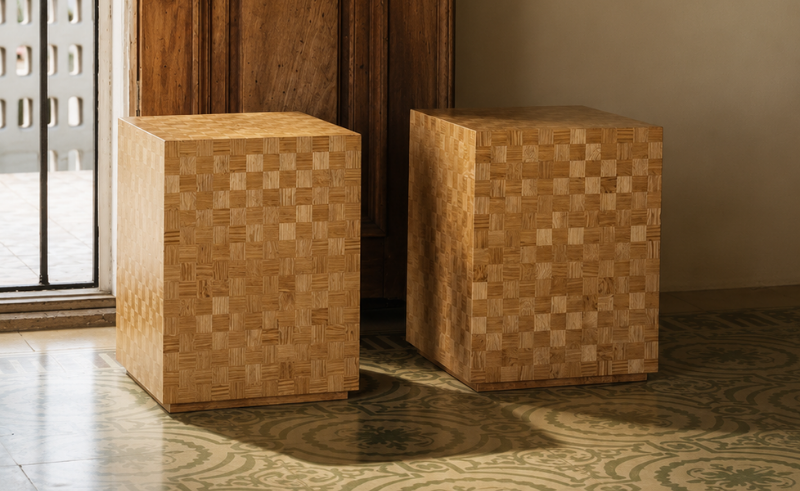 Look at one and you see a checkerboard, light squares against dark. There is no dark wood in it. Every square is the same timber. The studio's own specifications call it a sequential grain orientation, and it means Nasef lays the squares so that half are turned ninety degrees. Because wood reflects light along its grain, the turned ones read darker. It is the effect you see on a mown football pitch, where the stripes are one grass cut in opposite directions.
Walk around the table and the pattern reverses.
"I wanted the material to speak, because materials have history," she says.
She made the same design in three woods: American black walnut, American oak and African mahogany. Choosing them took weeks. She studied the grain and the pore structure of each species to find which would flip most sharply when turned, and the three tables read as quite different objects despite being identical in form.
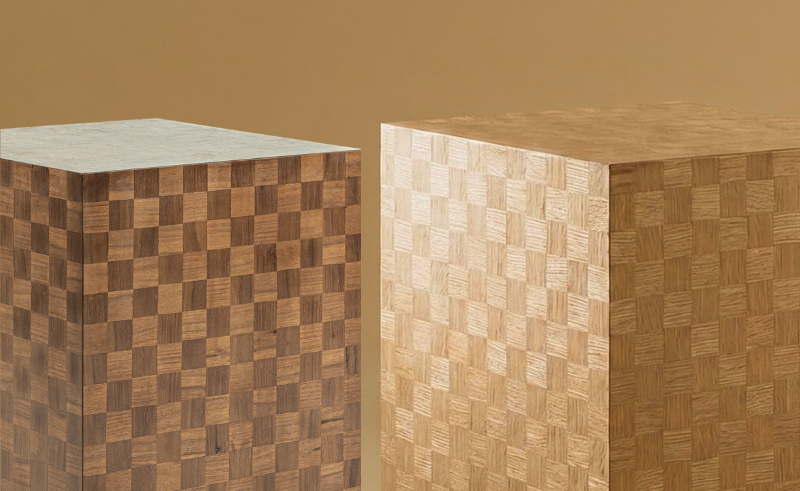 "It's a piece with so many tiny details, the more you explore it, the more details you discover," she says.
The corners are where the work shows. Most veneer goes onto a flat surface, where the edges can be trimmed and hidden. Nasef's pattern runs over five faces and has to meet at every corner, so the panels are cut at 45 degrees and joined like a picture frame.
Underneath, the tables are hollow. The body is 13mm fibreboard with the veneer on the outside, and each sits on a slim base set back from the edges so the cube appears to float. It weighs about as much as a full bag of groceries, light enough to move with one hand.
Nothing is stained or lacquered beyond a protective seal, so whatever irregularities the wood arrived with are still in the finished object.
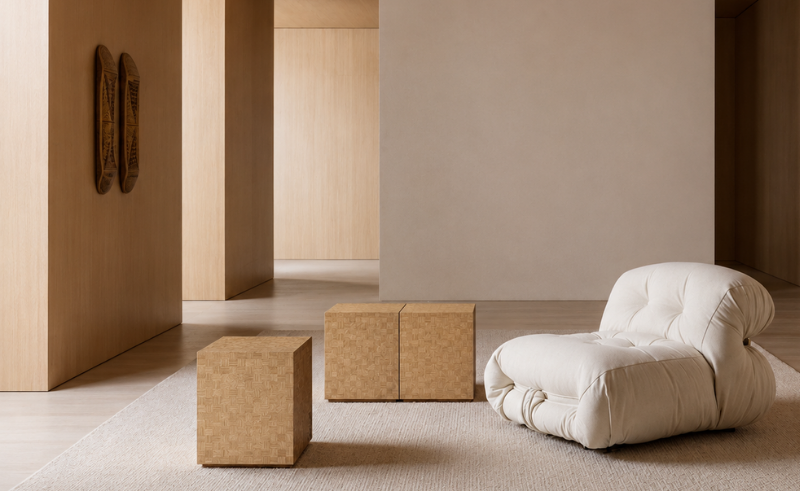 Nasef opened her studio, Na-sef, in Cairo this year, and these tables are its first release. She trained in interior architecture, took a scholarship for a master's at the Cambridge School of Art in the UK and lectured there, then came back to Egypt to work for herself. The studio runs between Cairo and London and the tables are made in Egypt.
"I don't want to make furniture that just looks good, I want to make products that don't exist," she says.
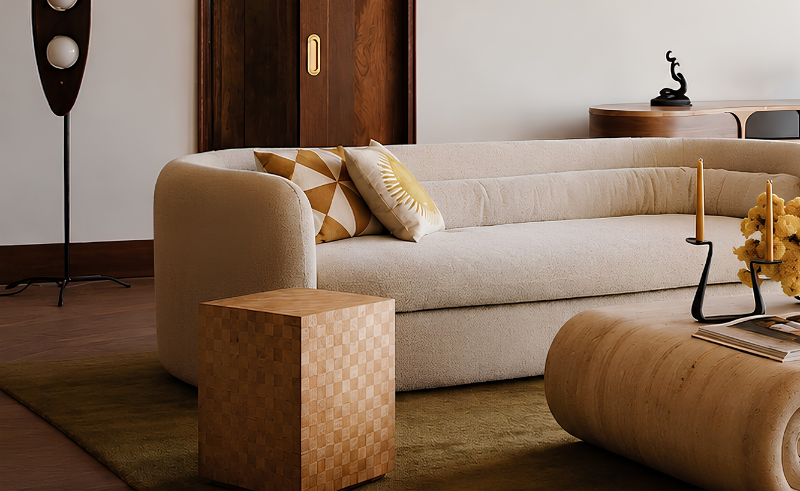 The walnut has been the popular one. In-stock pieces ship within five working days and made-to-order takes four to six weeks.
Her second collection, Threads of Wood, shows at Venice Design Week in October 2026 and Cairo Design Week in November 2026. She also spent time in the UK researching bioplastics made from plants rather than oil, which continues to feed into her work.
- Previous Article These MENA Walls Tell Stories Beyond the Landmarks
- Next Article The Intricate Beauty of Ben Youssef Madrasa