

The Negotiation of Light & Privacy in Kuwait's 'Shade House'
Designed by Kuwaiti design studio Massive Order, The Shade House choreographs light and shadow to resolve the tension between cultural privacy and natural daylight.

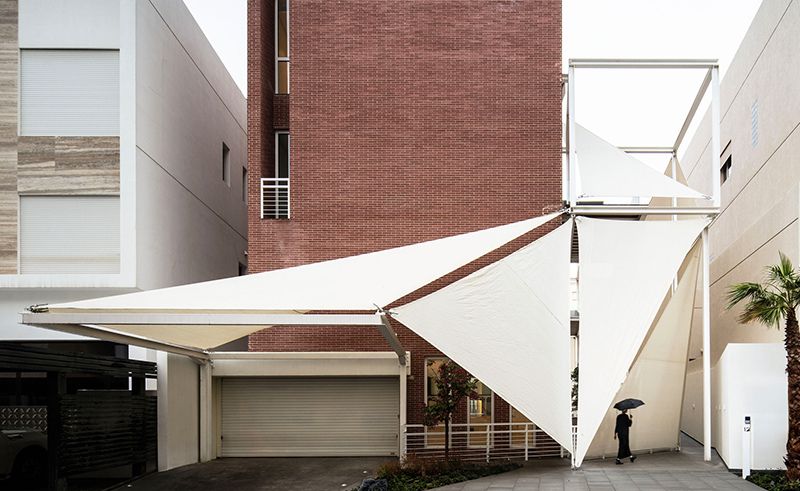
In Kuwait, where the sun is rarely absent, the architecture of this house is less about welcoming light and more about negotiating with it. Relentless sunlight shapes the climate, but shade shapes comfort and above all privacy, which is a constant cultural priority for the users of the house.
Kuwait-based firm Massive Order designed The Shade House, a stand-alone 400-square-meter villa that responds carefully to its context, translating these principles into spatial and experiential form and offering an elegant solution to the tension between privacy and natural light.
The house was commissioned in 2019 and completed in 2025 in Fnaitess, Kuwait. At first glance, the South facade appears largely opaque and restrained. However, a continuous band of windows placed strategically along the south-western side utilises the best orientation for direct sunlight. 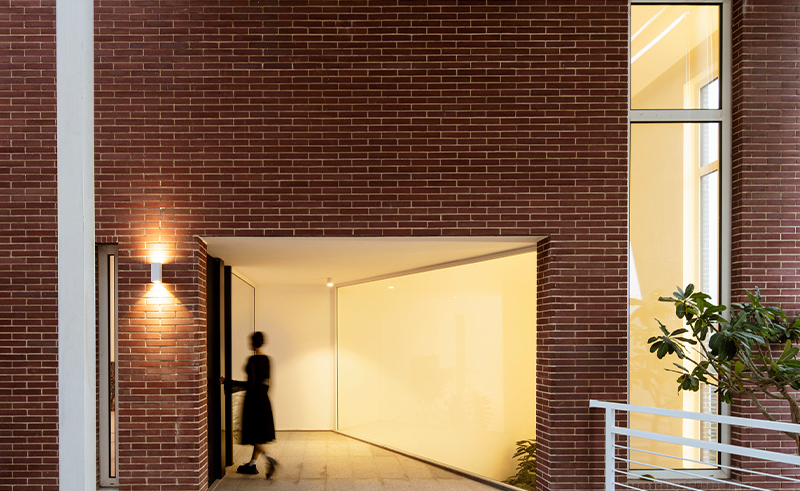
On the other hand, the eastern façade has a veil-like structure that conceals a sunken courtyard while filtering daylight. This apparatus is composed of triangular shades arranged to create openings that allow sunlight to enter the outdoor spaces selectively. The seating area within the sunken courtyard is carefully positioned to face south, taking full advantage of the filtered light provided by the structure.
The orientation and shading system does not only address the light issue, but it also tackles the privacy problem by completely concealing the sunken courtyard from external pedestrian view. “The result is a highly usable sanctuary defined by a choreography of light and shadow, demonstrating how a single architectural element can provide protection while celebrating natural light,” Muhannad Al Baqshi, head architect at Massive Order, tells SceneHome. 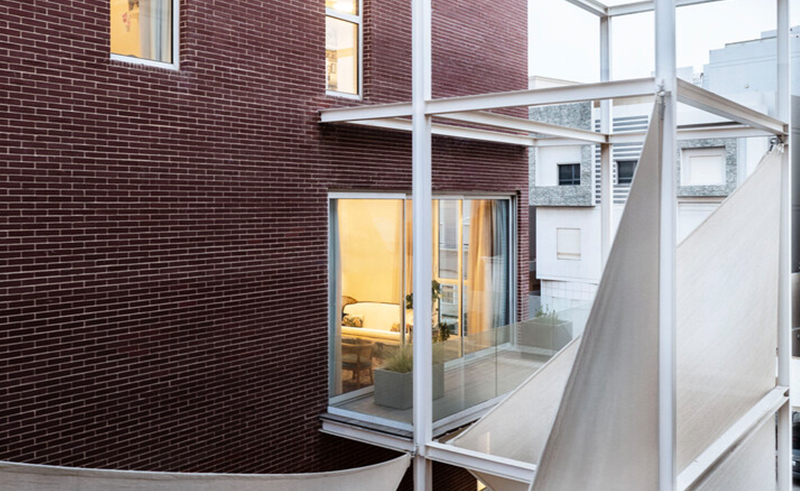
Walking inside, the interior uses double-height to unify otherwise distinct spaces. For example, the “Great Room” in the basement remains visually connected to the guest reception on the ground floor and the mezzanine above it, using strategic spatial voids to create vertical relationships between the rooms. Every main space also maintains a connection with the outdoor space, either through large sliding glass doors or balconies on the first floor.
The hallmark “Great Room” unifies four functions in one singular space, using an open-plan concept: a living & dining area, a kitchen area, a cinema room, and out-door gathering space. This encourages collective and family living even when occupants are engaging in different activities. The room design also rejects the stereotypical basement typology by transitioning seamlessly into the sunken courtyard. "The boundary between interior and exterior dissolves, creating an atmosphere that is expansive, interconnected, and flooded with natural light,” Al Baqshi explains.
Massive Order weaves a relationship between Light, Privacy and Community. Three things that are normally hard to associate together, yet are pivotal aspects in the Kuwaiti Culture. An important reminder that when design listens to its context, it can reconcile what seems incompatible without compromise.
- Previous Article HH Sheikha Bodour & Jaipur Rugs Unveil Desert-Inspired Carpets
- Next Article The Ancestral Resilience of Omar El Farouk’s Fayoum Home