

Koray Duman Designed the UAE's Venice Pavilion Around Sound Itself
This Turkish-American architect built a four-room journey for the UAE Biennale Pavilion where sound never leaks between pieces.
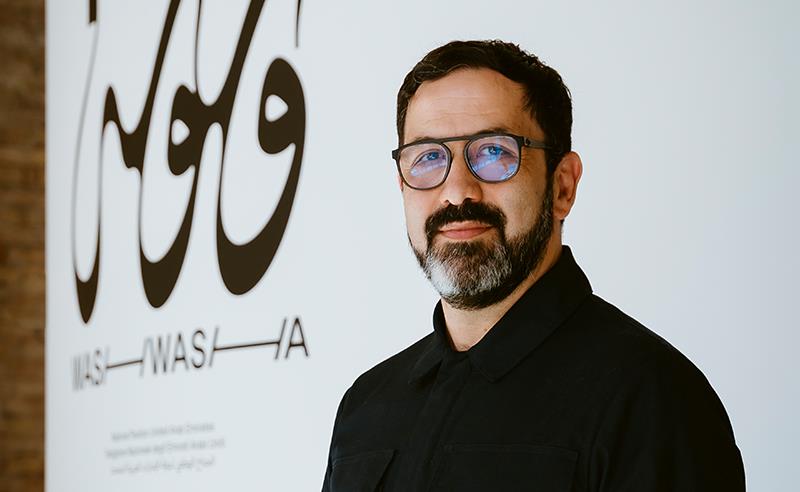
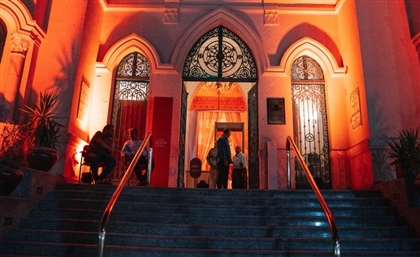
Büro Koray Duman Architects (B—KD) designed the UAE’s Venice Art Biennale pavilion around an intangible medium: sound. ‘Washwasha’, an Arabic word that means ‘whispering’, is the country’s 9th participation at the 61st edition of the largest art exhibition in the world, curated by Bana Kattan and assisted by Tala Nassar.
The founder of B—KD, a firm based between New York and Istanbul, is Turkish-American architect Koray Duman himself. This was his first time designing a Venice Biennale exhibition and working with any institution in the UAE. He took on another project in the Biennale’s Central Pavilion for American non-profit Denniston Hill’s multi-media installation, ‘Chimera’.
For ‘Washwasha’, Duman spent three months building out a four-room floor plan that created a journey through the six participating artists’ visual and auditory work—Mays Albaik, Jawad Al Malhi, Farah Al Qasimi, Alaa Edris, Lamya Gargash and Taus Makhacheva.
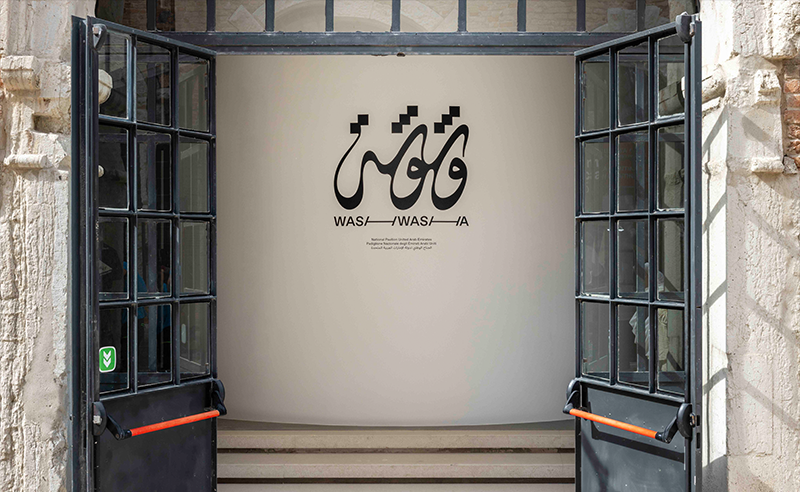
Installation view of Washwasha, curated by Bana Kattan
Courtesy of the National Pavilion UAE – La Biennale di Venezia Photo by Ismail Noor
Working with an intangible medium like sound raised its own particular kind of challenge. While Duman was designing, he asked himself: “How do you isolate sounds from each other so that the experience of each artwork is legible, but at the same time, support the storytelling of the creator?”
Duman had met head curator Kattan through a previous project, and she invited him to propose a plan for the UAE pavilion based on the first three ‘anchor’ pieces, all sound-based, before the exhibition had been finalized. Duman devised a plan to separate sound between installations using threshold corridors. “[Kattan] really liked that layout, because she was worried about sound bleeding,” he said.
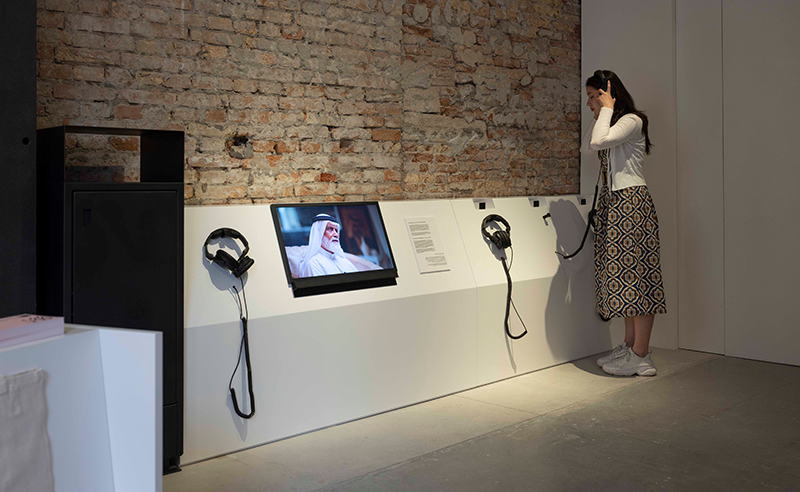
Installation view: “Voice of the Country” Program Activation
Courtesy of the National Pavilion UAE – La Biennale di Venezia Photo by Ismail Noor
Duman simplified the physics behind it: “Sound likes to travel in a direct vector,” he said. “So, if you are able to break that vector with walls, so that there's not a straight line from one space to another, that line is broken. Once the line is broken, the sound starts bouncing. Where it bounces, you put sound absorption material. It's a very effective way to control sound without barriers like curtains or doors.”
This is the logic he followed to separate each of the six artists’ installations—four sound, two visual—from each other without physical barriers that would disturb the visitor’s walking path.
‘Washwasha’ opens with Palestinian artist Al Malhi’s sound installation, ‘Naiman’. One enters a room shaped like the hammam—or traditional bathhouse—where the voices over its speakers originally came from. In this first room, visitors enter Hammam Al Ayn in occupied East Jerusalem, where men in their seventies recall the rituals they performed the night before their wedding. Here, Duman designed a curved wall and dome above to replicate the hammam’s architecture, and help the sound travel inside the room. A bench runs along the curve for people to sit down, relax, and experience the artwork—necessary for a day touring the sprawling Venice Biennale, but also something that is key to Duman’s philosophy of “generosity through design”, and “giving people agency in a space”.
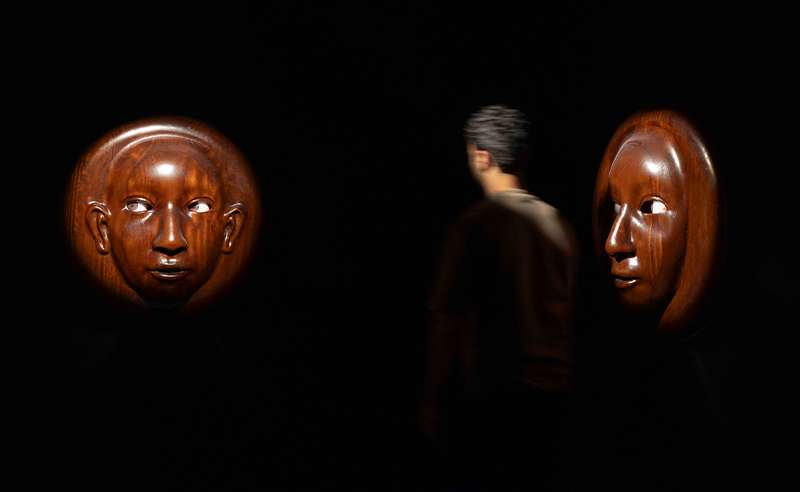
Alaa Edris, Wiswas, 2026. Iroko wood, 3D-printed animatronic eyes, sound
Courtesy of the National Pavilion UAE – La Biennale di Venezia Photo by Ismail Noor
“I’m hoping that people would really love to just sit and hang out in Jawad’s space while old men tell their stories,” he said.
Walking out of the first room, the voices quickly dissipate. Duman sandwiched the dome between sound absorbing material along the entrance and exit. Visitors make their way through a corridor that opens up to the courtyard in the middle of the pavilion, and houses three of the artists’ work: Albaik, Al Qasimi, and Lamya Gargash. Al Qasimi’s ‘The Curse’ on the back wall is the only one with sound, a nearly 20 minute film that follows the story of a child who believes that their scream brought a curse on their village. The sound fluctuates from quiet emotional moments, to loud outbursts of performance. The courtyard is the middle of the journey through the pavilion.
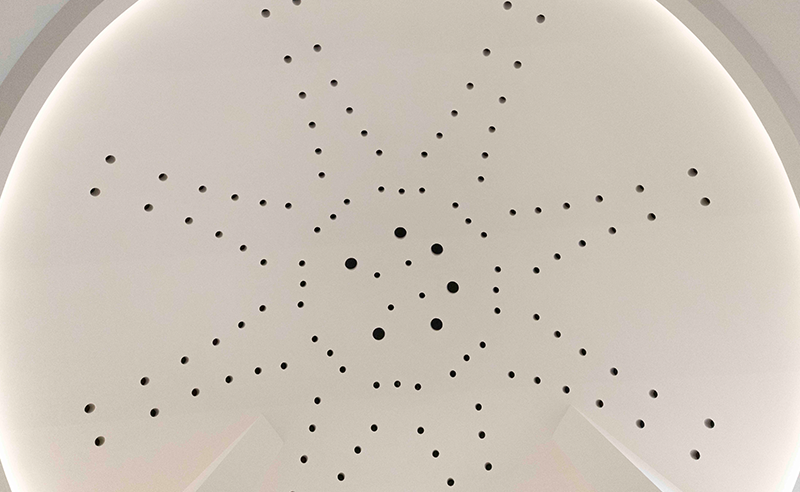
Jawad Al Malhi, Naiman, 2008/2026. Mixed media installation, sound
Courtesy of the National Pavilion UAE – La Biennale di Venezia Photo by Ismail Noor
From the courtyard visitors walk down a hallway made of sound absorbing material and are met by three faces staring at them in a dark room. This is Edris’ installation, ‘Wiswās’. Here, the architecture is used to conceal, not clarify. The distorted electronic noises shock the ear, and the senses. It sounds as if robots are crying, revealing the anxiety of our contemporary digital age.
“The architectural response to that is this very dark space where you can’t find the corners,” Duman said about how difficult it is to orient oneself in this room. Duman juxtaposes this installation against a room filled with human voices—Makhacheva’s installation, ‘Dear R., R.,…G.’, that closes out the UAE Pavilion.
52 speakers hang from the ceiling reading real emails apologizing, and making excuses, for not responding sooner sent during COVID-19. “Apologies for the late reply…” most begin in one variation or another. It is another kind of commentary on our hyperconnectivity, the expectation that we always have to be plugged in.
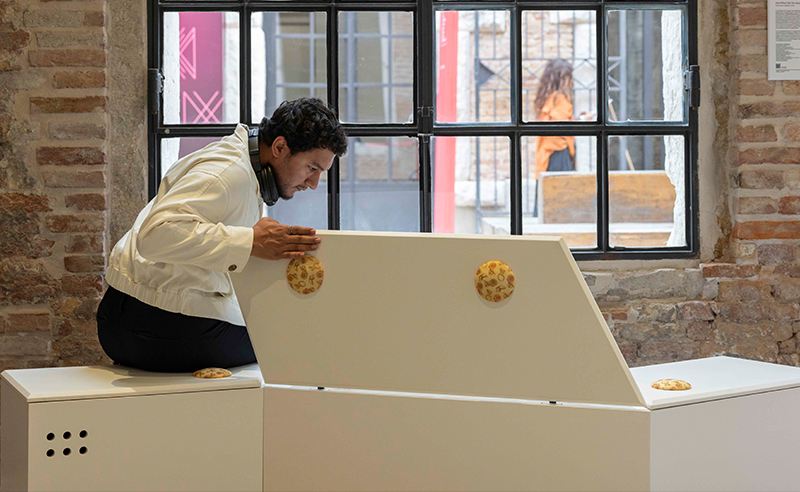
Taus Makhacheva, And What Did You Say?, 2026. Performance, installation, sound
Courtesy of the National Pavilion UAE – La Biennale di Venezia Photo by Ismail Noor
“We hear these sounds and voices through the digital world where there's almost no architecture,” Duman said, “so the space is a very generic color, where architecture disappears.”
The UAE Pavilion and Duman’s construction will be on display until the end of the Venice Biennale, on November 22nd, 2026.