

Sicily & the Afterlife of Norman-Arab Influence
In Sicily, Arab ceilings, Norman palaces, and citrus gardens reveal how conquest became cultural inheritance, and how architecture learned to speak more than one language.
Textbooks are stitched through with stories of lands igniting under conquest and nations crumbling with the last whispered promise of devotion. Stories that have pressed themselves into the fabric of culture, leaving people speaking in a shared tongue. The world we move through today has witnessed power unravelling and returning; blood spilt and sovereignty lost. But it has also nursed music, poetry, and a certain voluptuousness of living that refuses to be erased.
And yet we remain preoccupied with the division between East and West, a kind of fetish that feeds our screens and fuels the world’s hunger for rupture. The Mediterranean, though, has always pushed back against that script. It offers up lives that speak in different tongues, yet understand all the same. And there exists a particular island that stands as a living testament to how deeply cultures can seep into one another.
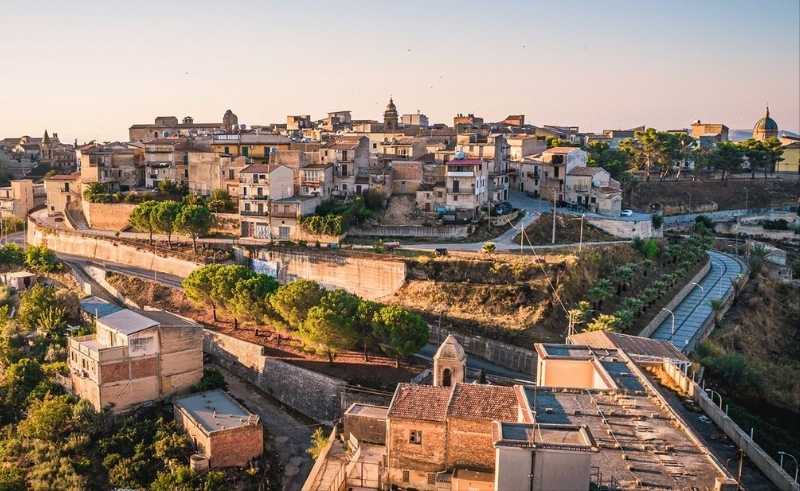
Sicily, steeped in sun and the scent of citrus, exists as a contested land of mixed heritage still trying to find its place in the world; a bridge that keeps two worlds tethered. Its architecture carries the imprint of Arab hospitality, something that has seeped into the daily workings of its narrow streets, into the way doorways open and courtyards breathe.
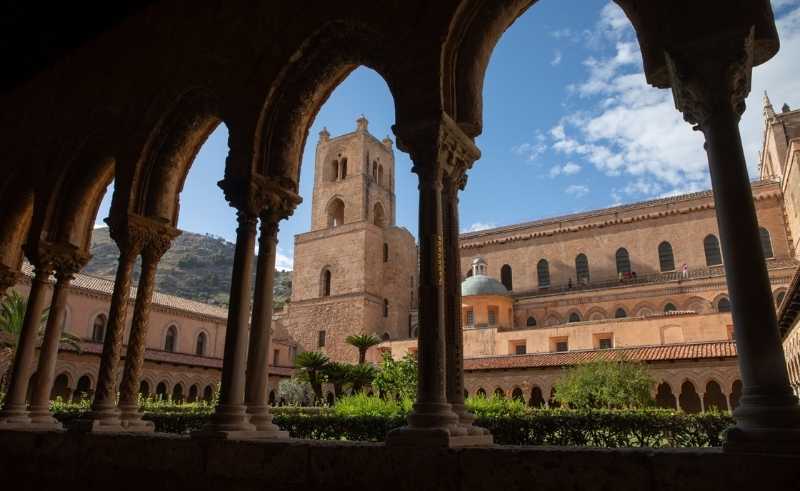
Stone, mosaic, and wood come together, conspiring to tell a story of peaceful coexistence within what is now celebrated as Europe’s oldest royal residence, the Palazzo dei Normanni. Standing inside it feels like stumbling across a silhouette of medieval multiculturalism—entirely out of place, and yet utterly at home. But before the Normans left their mark, this site belonged to another chapter: a ninth-century Arab fortress, a piece of Islamic military engineering that physically asserted a new ruling power on the island.
Seventy-five years of the haramlik and salamlik—the division of private and public, domestic and political—came undone when the island fell into the hands of the Normans. But instead of wiping away what stood before them, they made profound and calculated decisions to adopt the rooted Islamic past rather than writing it off as a symbol of “otherness,” thus engaging in a sophisticated act of political theatre. They were not merely preserving a building, but inheriting the prestige and administrative refinement of the Arabic court, stitching themselves into the city’s very fabric of power.
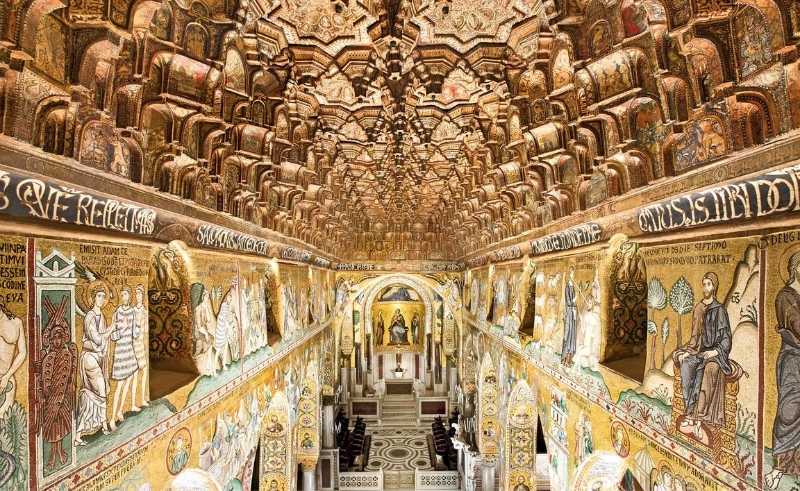
This strategy of assimilation reached its most exquisite expression when the Normans went as far as to commission Arab craftsmen to build the ceiling of Cappella Palatina, a muqarnas (Arabic stalactite vault) that looks like complex geometric honeycomb of tiny carved and painted wooden pieces fitted together with fiber bindings and animal glue.
Looking up, the ceiling unfolds like a painted manuscript of courtly life. Every surface is filled with scenes of musicians, dancers, men sipping from fine chalices, and hunters pursuing lions, leopards, and gazelles; manifestations of the Islamic concept of ‘aja’ib (marvels). Seventy-five elegant Kufic inscriptions weave blessings of power, prosperity, and health for the King.
The palace and its designated chapel (for every King needs room for repentance) exist as layered collages of Latin, Byzantine, and Islamic traditions threaded together; each still visible, still speaking, forging an architectural language where northern administrative order met the ornamental lyricism of the Mediterranean.
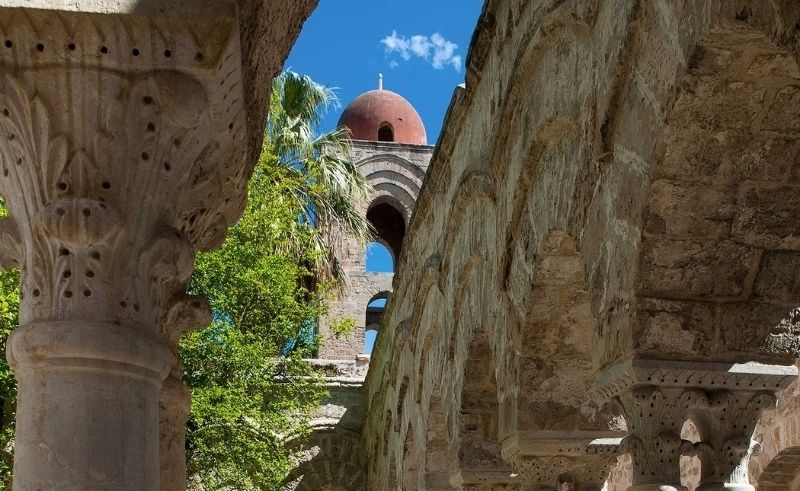
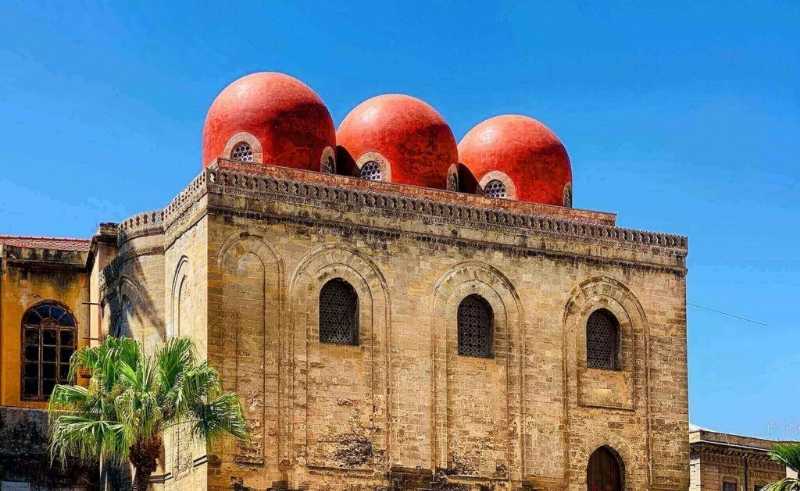
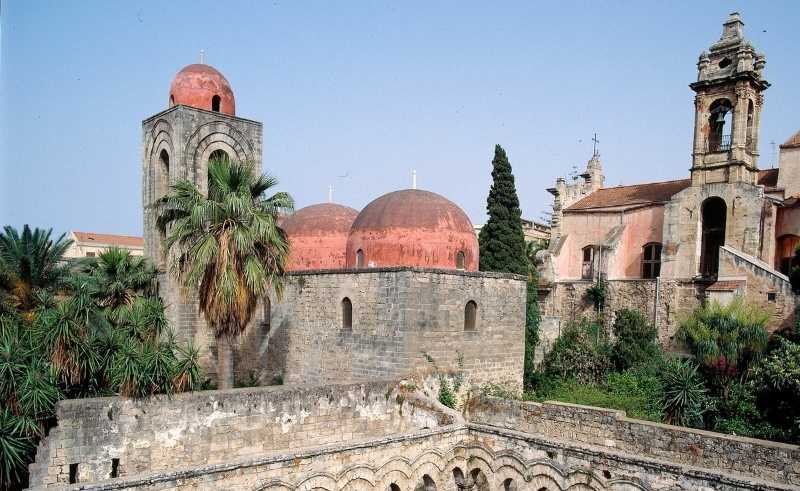
A few hundred metres southwest, in the warren of streets below, the echo of this quiet revolution surfaces in another register; the Chiesa di San Giovanni degli Eremiti rises. Five red domes sit clustered as the scorching Sicilian sun reflects something that drifted across the Mediterranean and chose to remain. Its walls are stripped back, its geometry bare, and there is a visual ambiguity to this Christian building that feels so persistently Islamic. Beside it rises a Gothic bell tower unlike any other, with four tiers of arched porticoes stacked one upon the other and crowned with a small dome. An architectural anomaly of Christian custom wrapped in Arab construction, as if the tower itself forgot which language it was meant to speak.
Beyond the grandeur of medieval architecture and wonder sits a park that’s very name leads to its Arab roots. Il Parco del Genoardo is a physical representation of the Islamic “paradise” on earth, deriving its name from the Arabic, jannat al ard (Paradise on Earth). The vast land it encompasses, from west of Palermo (known since as the Conca d’Oro or Golden Shell) all the way to Monreale, was cultivated with the advanced agricultural and hydrological knowledge the Arabs brought to the island centuries before.
In inheriting these gardens, the Normans inherited a ruling aesthetic: the idea that a sovereign’s power could be measured in his ability to create abundance, to make the land itself testify to his generosity. The Norman rulers didn’t tear out the citrus trees or redirect watercourses. Once again, they chose to recline in the same pavilions and looked out over the same cultivated valleys, presenting themselves as heirs to a tradition of kingship that understood dominion as cultivation.
Nowhere is this inheritance more ingeniously realised than at the Palazzo della Zisa. Its name, like the park it belongs to, is a transliteration of al-Azīza (the splendid one). At its heart lies the Sala della Fontana, where water issues from a salsabil and runs through channels that flow out into the surrounding gardens, cooling the air through evaporation. The same water that refreshes the interior then irrigates the gardens beyond, erasing any firm line between where the palace ends and nature begins. This is Islamic environmental intelligence surviving empires, where architecture works with the elements, making paradise tangible.
The Normans understood that you don’t need to speak the same language to inhabit the same space. The muqarnas ceiling doesn’t cease being Islamic because a Christian king prays beneath it. The water that cools the Zisa does not care which empire commissioned the fountain. These buildings are a form of architectural bilingualism, a built archive of cultural translation.
They have never resolved their identity, and neither has Sicily.
Walk through Palermo and you feel it. In the Kalsa district, the old Arab quarter, the streets still hold that familiar Mediterranean tightness; winding, shadowed, built for privacy and the surprise of sudden courtyards. At the Ballarò market, the calls of vendors drift through alleys that have looked much the same for a thousand years. The citrus trees that blanket the Conca d’Oro still fruit each winter, though few remember whose hands first terraced those hillsides. The oranges and lemons Italy is so famous for are themselves a kind of architecture—a cultivated landscape that became so thoroughly Sicilian that its origins were absorbed into the soil.
This is how deeply cultures seep. Not always through bloodlines or language, but through the way space shapes how people live. Sicily’s hybridity became normal. Its contradictions became its identity. The island disrupts the very separation of East and West, of “otherness,” offering instead a Mediterranean logic defined by exchange rather than division.
Perhaps this is why the words of Sidi Yahya-u-Ta'fuft, a 16th-century Morisco forced to navigate the aftermath of Spain’s own unresolved Islamic past, still resonate across the water:
The Moors say I am a Christian, and the Christians say I am a Moor, and so I hang in balance without knowing what I should do with myself…
Sicily knows that feeling, drifting in the in-between. Its buildings have carried it across centuries, never quite resolving, never choosing one language over another. And in their refusal to choose, they offer something rarer than certainty: a living testament that identity need not be pure to be real, and that cultures can hold more than one inheritance at once.
- Previous Article Nuba in El Gouna Adds a Colourful New Rhythm to the Red Sea Coast
- Next Article The Ancestral Resilience of Omar El Farouk’s Fayoum Home