

How the Circle Shapes Power & Space Across the Middle East
The circle seems innocent, yet from Abbasid Baghdad to Medina’s trench and Bentham’s Panopticon, it has staged power, protection and control through space.

Like the endless digits of pi (π), the circle assumes neither beginning nor end. It turns endlessly upon itself, a line that closes without interruption, suggesting a form untouched by hierarchy or direction. To move along its edge is to arrive, inevitably, where one began. This apparent equality is precisely what has made the circle so seductive to those who wish to organise the world within it. For centuries, architects and rulers alike have been drawn to its geometrical promise of equal parts perfection and continuity—an unbroken line capable of enclosing, organising, and sometimes quietly determining the perfect order of the world within it.
So when the Abbasids overthrew the Umayyad dynasty, the second caliph, Ja’far al-Mansur envisioned a fortress-city that performed power, one that commanded an army and enforced surveillance with equidistant range. He chose Baghdad, naturally, a central point that anchored the great routes that bound the riches of the Far East to the mercantile Mediterranean world.
Much of the information on al-Mansur’s Baghdad has been lost, including the names of the four architects he commissioned. Fallen soldiers aside, in 762, the Caliph’s court brought together Persian scholar Naubakht and Persian-Jewish astrologer-astronomer Mashallah ibn Athari to draw up the plans for a city arranged in cosmological order, its geometry echoing the harmony of the heavens (because the stars always made sense, humanity has always known that lights will guide you home).
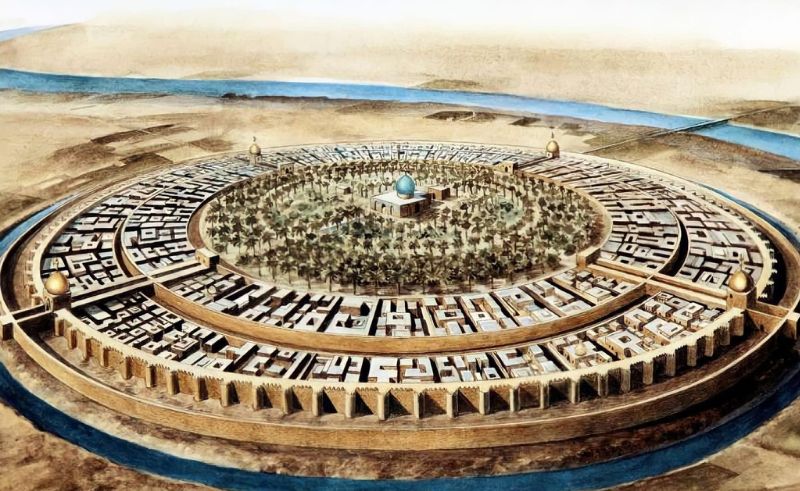
The celestial order translated to a terrestrial shape: Baghdad was conceived—by 100,000 workers no less—as a perfect circle, nearly two kilometres in diameter. Its circumference was girded with towering mud-brick walls and a protective moat, an enclosure that guarded the city but also defined who and what could exist within it.
At measured intervals, four gates opened the Round City of Baghdad to the empire beyond, where movement was channelled through these openings with intention. To pass through them was to submit, briefly, to the logic of the plan. It was a city that didn’t simply receive travellers but processed and organised them.
Within its walls, one submitted to the order of concentric rings that placed life into legible bands. The rhythms of daily life hummed closest to the defensive edge: markets, barracks, and residences. Closer in, administrative quarters gathered those responsible for the machinery of governance, and at the very centre—as though placed on the pivot of a compass—stood the caliphal palace alongside the congregational mosque. Proximity was not at all accidental. The closer one stood to the middle, the closer one stood to authority. Order did not need to be enforced loudly in a city whose geometry already made it clear to those who governed it. The circle did more than just enclose Baghdad; it arranged life into quiet bands of privilege around a sovereign core.
But nearly a century before Baghdad rose in its measured perfection, another circle appeared in Arabia. It wasn’t drawn in ink nor raised in brick and had no interest in permanence. It was carved into the earth in haste in an effort to prevent collapse.
In 627, during the Battle of the Trench, the city of Madinah faced an advancing coalition whose greatest advantage lay in cavalry and open terrain. At the suggestion of Salman the Persian, a trench was dug around the vulnerable sides of the city, a continuous cut in the ground that transformed the landscape from passage into barrier.
This, too, was a circle, but where Baghdad’s rose from the earth to enclose, this one sank to repel. It was a negative architecture defined by absence rather than mass, shaped by collective labour rather than decree. There was no palace at its centre, no administrative ring, and no geometry intended to endure beyond the immediate threat. People dug side by side, not in service of spectacle or permanence, but out of absolute necessity and survival. So once the battle was won and the danger passed, the trench lost its purpose.
Where Baghdad’s circle radiated hierarchy outward from its centre, this circle consolidated protection at its perimeter—resisting power rather than staging it.
Long after these early forms, the circle would return in a different guise, no longer as a city or a tactic, but as a diagram of thought. In the late eighteenth century, Jeremy Bentham sketched a Panopticon, a circular prison arranged around a central watchtower. Those placed along its perimeter could never know when they were being observed, and the possibility of a gaze—rather than the gaze itself—became enough to produce order. The circle was neither monumental nor defensive, but psychological. Power no longer needed to declare itself through walls or trenches but worked quietly through the internalisation of visibility.
And so, the circles of Baghdad and Madinah cease to feel like distant history. Instead, they read as early demonstrations of how a space can organise authority, protection, and behaviour without ever changing its shape. The circle, it seems, has never carried a single politics of its own, it just simply adapts to the kind of power that draws it.
And today, as circular masterplans, gated compounds, and smart cities promise efficiency, harmony, and control in equal measure, the question lingers: what kind of circle are we building now, and for whom?
- Previous Article Test 2026-10-27
- Next Article The Ancestral Resilience of Omar El Farouk’s Fayoum Home