

How Texmar Wove Its 110-Year Story Into Cairo Design Week
Texmar’s century-old textile legacy meets contemporary design through a collaboration that reshapes its role in Egypt’s creative landscape.

Texmar’s story doesn’t begin in a factory outside Cairo. It begins in Mardin, in southeastern Turkey, where a textile merchant moved between Turkey, the Levant and Egypt in the early 1900s. His son, Mohamed Mardini, went on to establish Texmar in 1976 as a home textiles manufacturer, extending a family lineage that now spans more than a century. “My family’s been in the business for almost 110 years,” says Ali Mardini, the fourth generation to take it forward.
-c00afac1-c19d-4e00-997b-94b65274631d.jpg) Today, Texmar is a vertically integrated manufacturer producing fabrics for the built environment — curtains, upholstery, and a range of automotive and technical textiles. Over the decades, its materials have made their way into hotel rooms and lobbies across Egypt and the region, including properties such as Four Seasons, Marriott and St. Regis.
Today, Texmar is a vertically integrated manufacturer producing fabrics for the built environment — curtains, upholstery, and a range of automotive and technical textiles. Over the decades, its materials have made their way into hotel rooms and lobbies across Egypt and the region, including properties such as Four Seasons, Marriott and St. Regis.
-36d4e676-0445-4a54-b96f-405a4752018b.jpg)
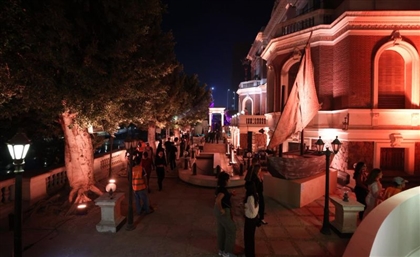
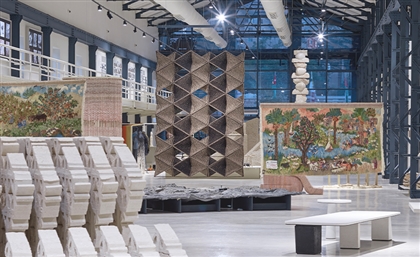
Cairo Design Week became a moment where that long, industrial muscle memory crossed over into the city’s design conversation. When creative director and founder of Cairo Design Week. Hisham Mahdy, called, he was looking for a textile partner who could produce custom pieces quickly, at scale, and on the ground. Texmar stepped in as the exclusive textile partner for the week, supplying custom printed, dyed and woven fabrics for several key sites: the “Second Skin” installation at Heliopolis's Ghurnata, interior displays in Zamalek, and elements in Downtown Cairo's Café Riche building.
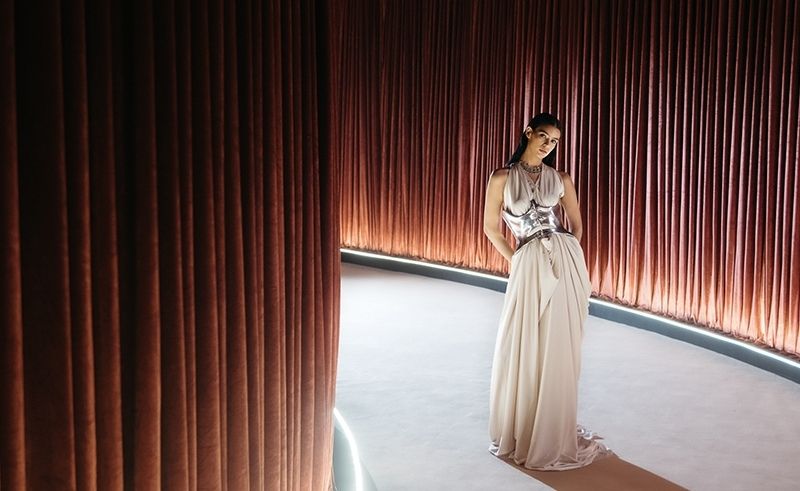
-996dc940-0889-460a-8510-eb45bafeca51.jpg) Inside Ghurnata, the brief was to make fabric feel almost weightless. Mardini’s team leaned into gradients, sheers and layering. “We wanted a very flowy and very airy sense,” he explains. The result was less a static backdrop and more a moving skin that changed through the day as light moved across the rooms. All of it was designed, sampled, tested and delivered in under a week – only possible, Mardini notes, because the entire chain, from yarn to finishing, sits under one roof.
Inside Ghurnata, the brief was to make fabric feel almost weightless. Mardini’s team leaned into gradients, sheers and layering. “We wanted a very flowy and very airy sense,” he explains. The result was less a static backdrop and more a moving skin that changed through the day as light moved across the rooms. All of it was designed, sampled, tested and delivered in under a week – only possible, Mardini notes, because the entire chain, from yarn to finishing, sits under one roof.
-456a09ce-8347-4893-b822-7958aba0bbef.jpg) For the team, there was a suspense in not seeing the full picture until everything was finally installed. They’d worked from architectural renders and 3D visuals, but the real reveal happened on-site, when their fabrics met other designers’ objects, lighting and sound. “As a textile partner, unlike other exhibitors, our responsibility is to make sure everything else looks good for everyone else,” Mardini says.
For the team, there was a suspense in not seeing the full picture until everything was finally installed. They’d worked from architectural renders and 3D visuals, but the real reveal happened on-site, when their fabrics met other designers’ objects, lighting and sound. “As a textile partner, unlike other exhibitors, our responsibility is to make sure everything else looks good for everyone else,” Mardini says.
-d73610a9-4445-4068-8d31-cebf8c7d8801.jpg) What stays with him from Cairo Design Week isn’t just the visuals, but the collaboration itself. Texmar has long worked with international design firms, but this felt different: a concentrated dialogue between Egyptian designers and an Egyptian manufacturer, happening in real time and in the same city. “When designers really work and click with Egyptian manufacturers, it really sort of expands the space,” Mardini says. “This sort of mutual dialogue between designer and manufacturer is what drives the wheel forward for both manufacturing and design in Egypt.”
What stays with him from Cairo Design Week isn’t just the visuals, but the collaboration itself. Texmar has long worked with international design firms, but this felt different: a concentrated dialogue between Egyptian designers and an Egyptian manufacturer, happening in real time and in the same city. “When designers really work and click with Egyptian manufacturers, it really sort of expands the space,” Mardini says. “This sort of mutual dialogue between designer and manufacturer is what drives the wheel forward for both manufacturing and design in Egypt.”
- Previous Article Mai-t Studio Debuts at Cairo Design Week With Plastic Installation
- Next Article The Ancestral Resilience of Omar El Farouk’s Fayoum Home