

Amr Helmy Writes a Story Before The Kitchen at Milan Design Week
Three kitchens, three design positions, and one question shaping how we live today at Milan Design Week.
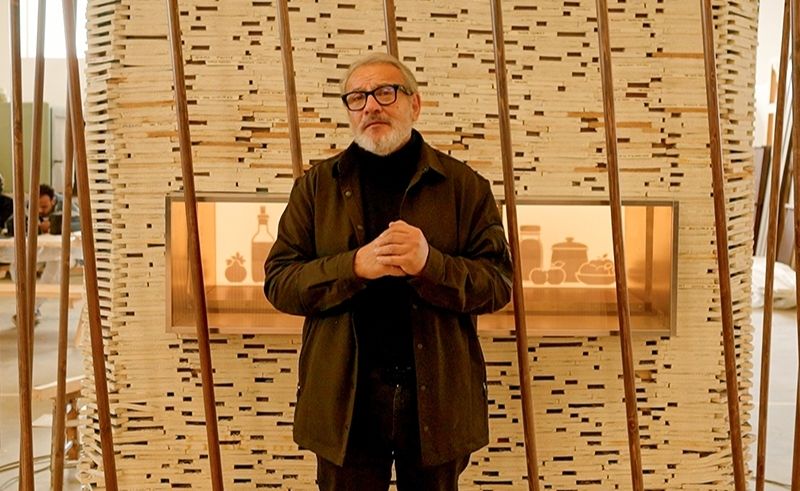
At Milan Design Week, Egyptian Designer Amr Helmy welcomes us into his kitchen, a space that unconventionally began with writing, not sketching. Before the installation, there was a book, rooted in the rise and fall of the Bauhaus and referred to as the Cairo letters, a reflection on modernism from a Cairo-based perspective placed in dialogue with history, culture, and place.
From that narrative, the project unfolds into sketches and then into space. “You are watching an illustration of a book that turned into sketches that turned into an installation,” he explains, using the kitchen to ask a direct question: should design move forward, step back, or stand still?
The installation is called ‘Three Kitchens. Three Positions. One Question.’ It brings together three spatial ideas, each based on a different way of thinking about how kitchens are designed and used. “You are watching an illustration of a book that turned into sketches that turned into an installation,” says Amr Helmy, Founder of Amr Helmy Designs.
The first kitchen, the Victorian capsule, is built around repetition and inherited routines. The layout follows familiar domestic structures, shaped by tradition and everyday habits passed down over time.
The second kitchen shifts into a Bauhaus position. Everything is reduced to function and clarity. Surfaces and storage are stripped down, and the layout is direct and structured. At the centre, the footprint of the Bauhaus school is reinterpreted at a domestic scale, placed as a reference inside the space. “The Bauhaus established a position that continues to shape how we live, to this day,” says Helmy.
The third kitchen, called the Isistron capsule, moves towards systems driven by automation and structured knowledge. Instead of fixed routines, the space responds to changing conditions. A curated set of foundational texts is built into the kitchen, acting as a constant reference that informs how the space is used and adjusted.
At the centre of the room, the Serpenti wardrobe introduces automated storage at a different scale. “It is an island hanger unit that can take up to 600 pieces,” says Ahmed Amr Helmy, Vice President at Amr Helmy Designs. “It’s foot pedal operated, and you can store items at the top or bottom.” On the opposite side, a motorised shoe rack moves up and down to reveal pairs stored behind, while backlit units and sculptural handles add further detail to the system.
“The idea was to place three positions next to each other and let them speak, not to resolve them, but to show how each one still operates today,” says Helmy.
At the core of Amr Helmy Designs is a practice based in Cairo, running since 1981, working across kitchens, wardrobes, and custom joinery. “At Amr Helmy Designs, we have always worked through the kitchen. It is one of the few spaces where behaviour cannot be separated from design,” says Helmy.
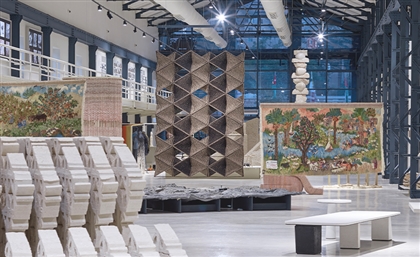
A series of chairs is also presented within the exhibition, continuing the same approach across smaller domestic objects.
“We need to go back to books. This is how we can rebuild our humanity. I hope more Arabs come with ideas that belong to their culture,” says Amr Helmy.
- Previous Article David/Nicolas Explore Functional Wood Panelling at Milan Design Week
- Next Article The Ancestral Resilience of Omar El Farouk’s Fayoum Home