

Ramy El Quorashy Infuses Egyptian Furniture with Mathematical Precisio
For Ramy El Quorashy, geometry class was never just another subject on the timetable. It was where he found his passion.

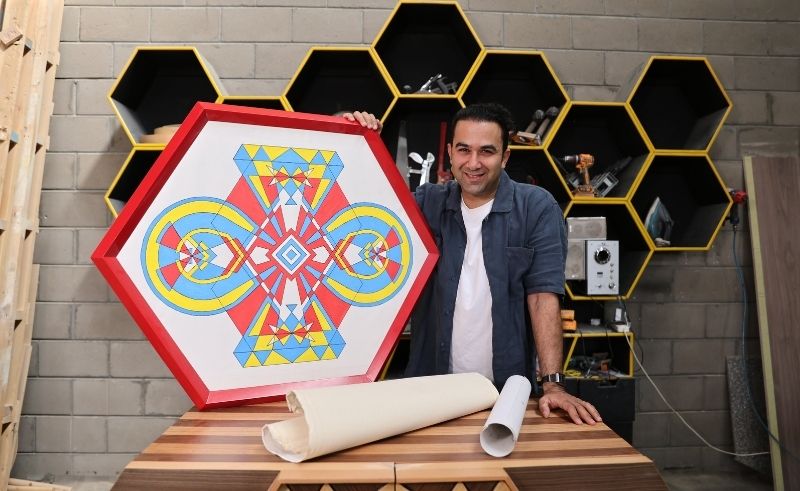
For Cairo-based designer Ramy El Quorashy, what began as a fascination with symmetry and balance eventually grew into Symmetrica Creations, his furniture brand dedicated to turning geometric art into functional pieces for everyday living. Through the brand, El Quorashy creates sculptural tables, consoles, and custom furniture that merge artistic expression with practical design.
His interest in patterns and structure first emerged in geometry class. While many students approached the subject as a set of formulas and diagrams, El Quorashy found himself drawn to the logic behind it. “Geometry was love at first sight,” he says. “I fell in love with logical solutions. Everything in geometry has logic behind it.”
-49fdbfb2-3b8b-4e42-997c-f4062679d90f.jpg)
Like many children, he loved to draw. Over time, however, he noticed that most of his sketches shared one defining characteristic: they were symmetrical. It was a defining moment, when he discovered his creative language, one through which he could express ideas and emotions.
“My art would come out as lines, very random lines that weren’t very understandable to people but were very clear to me,” he explains. “They expressed different feelings.” As his curiosity grew, he began exploring the mathematical and philosophical ideas behind geometric patterns. “I discovered that geometry is the language of the universe. Everything follows sequences, from odd numbers to the Fibonacci sequence. That’s where I truly fell in love.”
-3c54e1c0-8eea-4edf-b264-7cafe90b96a1.jpg)
Despite this early passion, El Quorashy’s professional path initially led him elsewhere. After graduating, he spent eight years working in corporate banking. The structured world of finance, however, never replaced his creative instincts. Throughout those years he continued drawing while quietly developing the ideas that would eventually shape his design practice.
Gradually, he began imagining how his patterns could move beyond paper and into physical objects. Instead of remaining purely artistic expressions, they could become something people interacted with every day. “I wanted to apply my art onto materials people could actually use,” he says. “Not just art hanging on a wall, but something functional in everyday life.”
-cbcf8ba7-a7e7-4049-9eb3-95e48d19755c.jpg)
This realisation led him to furniture. As he refined his sketches into more structured patterns, he noticed that people responded instinctively to the sense of balance they created. “Symmetry naturally triggers balance,” he explains. “When someone looks at something balanced, it gives them a sense of comfort.”
-3dff0dfb-14ec-444f-80e6-5db06ac3020b.jpg)
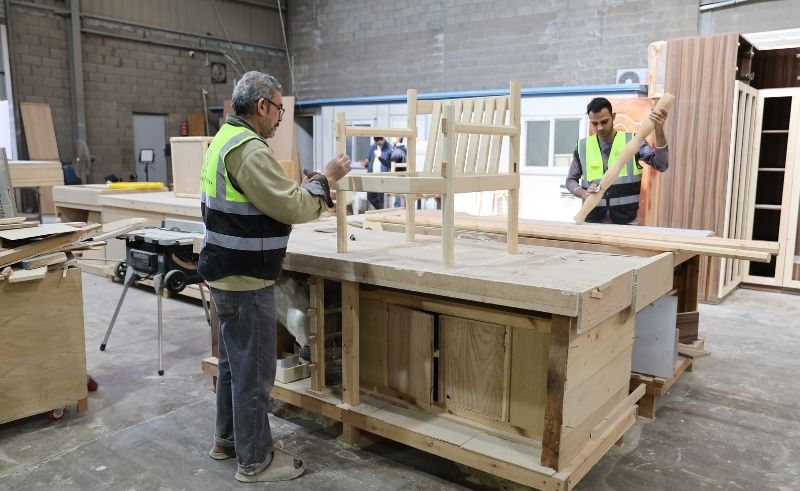
While still working in banking, El Quorashy began spending his evenings in carpentry workshops, learning the craft from the ground up. He studied design software, experimented with materials, and worked alongside carpenters and engineers to understand how raw wood becomes a finished piece of furniture. “At first, I knew nothing about furniture,” he says. “I had so many questions. How do I make a chair? How do I make a table?”
-73b193b5-0eab-414a-a61b-4f6a7eb13501.jpg)
The learning process exposed him to every stage of production, from concept sketches to machine work and manual craftsmanship. “Machines are the soul of the factory,” he notes, “but craftsmanship is irreplaceable.”
The turning point came when he applied one of his geometric patterns to a coffee table. The experiment immediately resonated with people, encouraging him to expand the concept further. Suggestions soon followed: a bed headboard could carry the same geometric language, and other pieces could incorporate similar patterns. That idea eventually became Symmetrica Creations, a brand built around the concept of functional art.
-8fe61a95-0e31-45f9-8f7a-f5314f11e5c4.jpg)
After gaining enough experience in production and design, El Quorashy left his banking career to focus entirely on the brand. Over time, he moved from producing pieces in different factories to establishing his own workshop, allowing him to maintain control over quality, timing, and design integrity.
Today his work draws inspiration from a wide range of sources, including nature, historical references, and philosophical concepts. One example is the Khufu Console, inspired by the geometry of the Great Pyramid. Viewed from above, the console mirrors the pyramid’s structure, while hidden within the design are six concealed drawers.
Discovery is part of the experience. “The user must be curious,” he explains. “Curiosity builds until they explore the piece and discover the hidden drawers. Furniture shouldn’t just be functional. It should create a conversation between the user and the piece.”
-4790e822-3659-47ba-a14d-dfd60da99f32.jpg)
The most rewarding moment for El Quorashy comes when a finished piece finally reaches its new home. By that stage, it has already passed through sketches, digital models, carpentry, and finishing. “Seeing the journey from sketch to computer to carpenter to finished piece, and then seeing the client’s reaction, that’s the best part,” he says. “Their happiness motivates me to continue.”
-3ff2f1ca-e5fc-4b44-af54-f565a8da302e.jpg)
He laughs when describing his relationship with his creations. “All my pieces are like my children,” he says. “When I deliver one, I tell the client: take care of it. I’ll come visit it later.”
Related Articles
Trending This Month
-
-
 Mar 13, 2026
 -
-