

Dubai-Based Studio Designs a Coffee Shop Shaped by How Locals Gather
Dubai-based IDST redesigns a Fujairah café, bringing the building’s warm sand-coloured walls indoors.

Interior projects rooted in existing buildings often begin by reading what is already there. For Press, located in one of Fujairah’s older districts, the redesign was shaped by the character of a long-standing neighbourhood café and the structure that contained it.
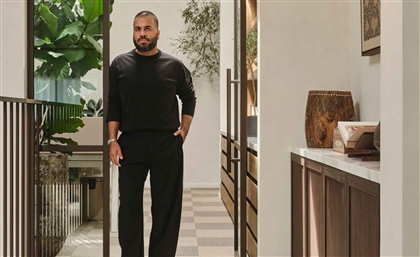
Founder and Design Director Hana Akram of Dubai-based studio IDST, describes the project as beginning with the building itself. “When we approached the site, the first thing that stood out was the colour of the exterior walls,” she explains. “It’s very weathered, very worn, but it has a warmth to it.” Her main idea was to bring the presence of the old structure indoors, allowing the interior to develop as a continuation of what already existed. “We really wanted to bring that colour inside,” she says. “That became the starting point, and everything else evolved from there.”
The café is located in an area shaped by routine and familiarity, where Press has operated for several years. “Every city in the UAE has its own culture, so we had to understand the coffee culture of Fujairah,” Akram notes. “It’s not common to have a design-led coffee shop there, so we had to be careful not to lose that neighbourhood feeling.” This understanding informed decisions around layout and seating, with the interior organised to support both smaller groups and larger social gatherings.
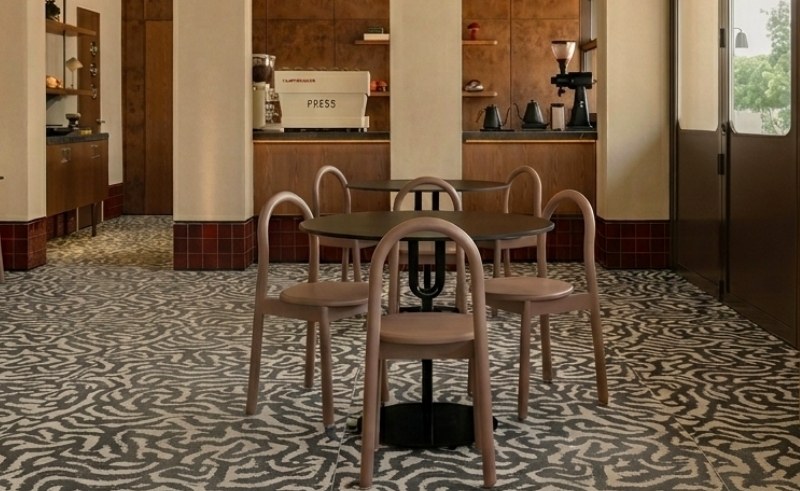
Movement through the space follows a clear spatial hierarchy. Walls, columns, and thresholds guide circulation from the entrance towards the bar and dining areas while maintaining open sightlines. “People there like to sit in corners and also come in big groups,” Akram explains. “So we really had to cater to that in terms of seating.” The bar occupies a central position within the plan, reflecting its role as a focal point within the café. “They wanted the bar to be a main feature, so it takes up a big part of the space,” she adds.
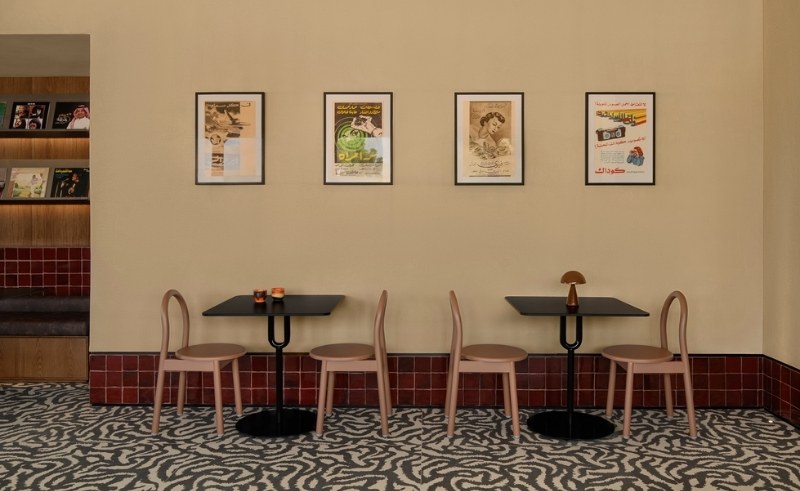
The spatial concept is informed by the idea of “pressing pause,” expressed through a sequence of layered spaces that unfold gradually. Areas of openness are balanced with more contained corners, creating a rhythm of movement and rest without fragmenting the interior.
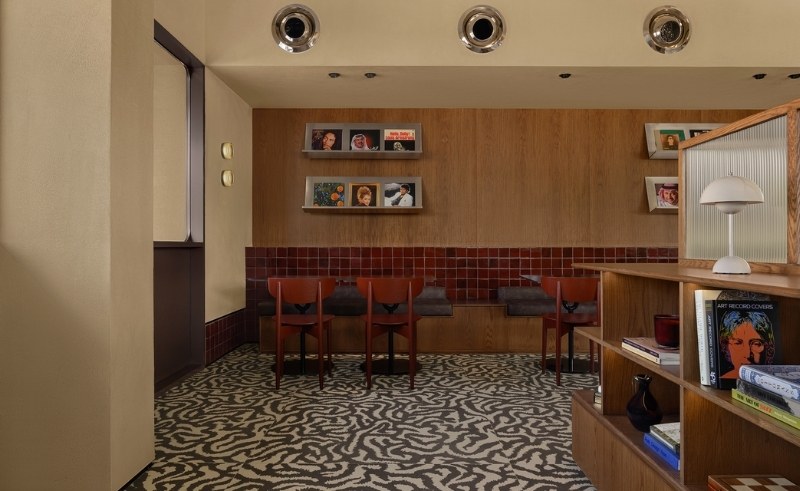
Materiality reinforces this structure. The flooring, described by Akram as “the main feature of the space,” uses neo-expressionist porcelain tiles. “It looks almost like a carpet, but it’s actually tile,” she says. Sand-toned plaster walls establish continuity across the interior, while rustic leather seating and handmade burgundy ceramic tiles introduce depth and contrast. “The burgundy tiles were meant to bring in a retro cue,” Akram explains. “They’re handmade, locally produced, and they really helped anchor the palette.” A burlwood back wall and counter further reference materials associated with interiors of the 1970s and 80s.
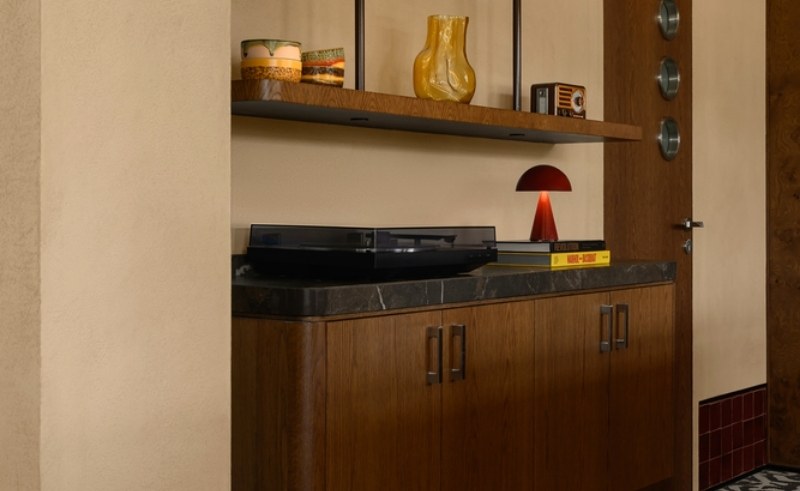
Lighting supports the spatial sequence through a balance of daylight and diffused artificial sources. Lightbox signage draws on familiar diner references. “They’re very simple elements,” Akram notes, “but they guide the space and tie into the overall memory of the café.”
Styling completes the interior through carefully sourced objects. Vintage radios, clocks, record players, and Arabic graphic prints are distributed throughout the space, contributing to a layered narrative rooted in regional culture. “We found original records from Lebanon, and they actually work,” Akram says. “When you walk in, it’s older Arabic music playing. The music, the objects, the books — they all tie back to Arabic culture, whether local or regional.”
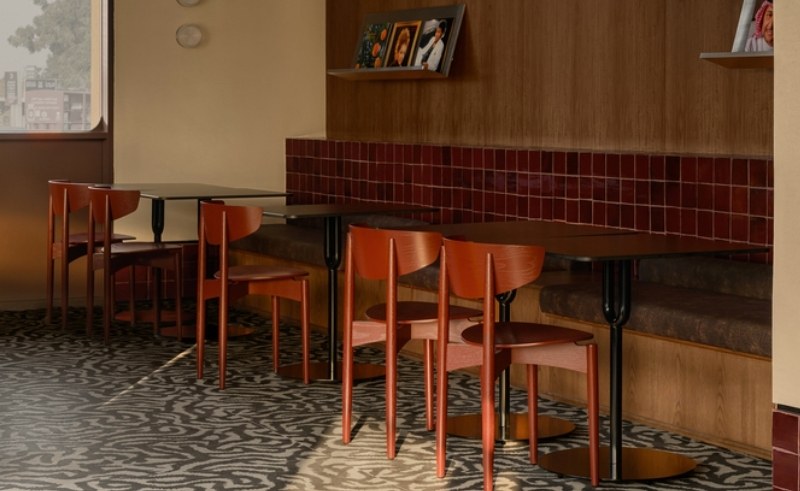
For Akram, the project’s significance lies in its relationship to place. “It’s really that neighbourhood café that everyone can go to,” she reflects. “Being in Diba, in Fujairah, makes it special. It’s very specific to where it is.”
- Previous Article Kids With Rugz Shapes a Tufting Studio in Cairo
- Next Article The Ancestral Resilience of Omar El Farouk’s Fayoum Home