

A Lebanese Student’s ‘Human Shield’ Design Turns War Rhetoric Around
When survival is at stake, what do we value most? Lebanese student Sleyman Haber turns this question into 'LIFESTRAP', a provocative design confronting conflict and media narratives.

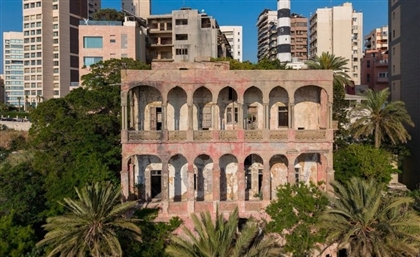
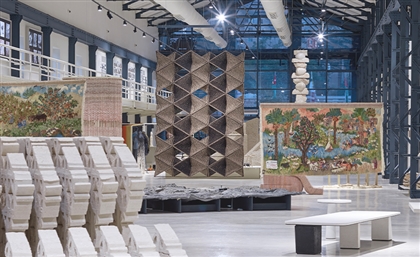
In 2025, as Lebanon was just recovering from another turbulent chapter, Burj el Murr – a relic of Lebanon’s wartime destruction and political instability – became the site of a student exhibition held during We Design Beirut’s second edition. The exhibition, titled 'Design in Conflict', featured work by students from nine Lebanese universities, positioning them as first responders to conflict and encouraging them to engage critically with pressing realities through architecture, design, and art.
Among the participants was Sleyman Haber, a 20-year-old product design student from ALBA University, who examined this topic further by asking a deceptively simple question: What do we truly value when survival is at stake? What is the first thing you should take with you? His answer was clear: humans.
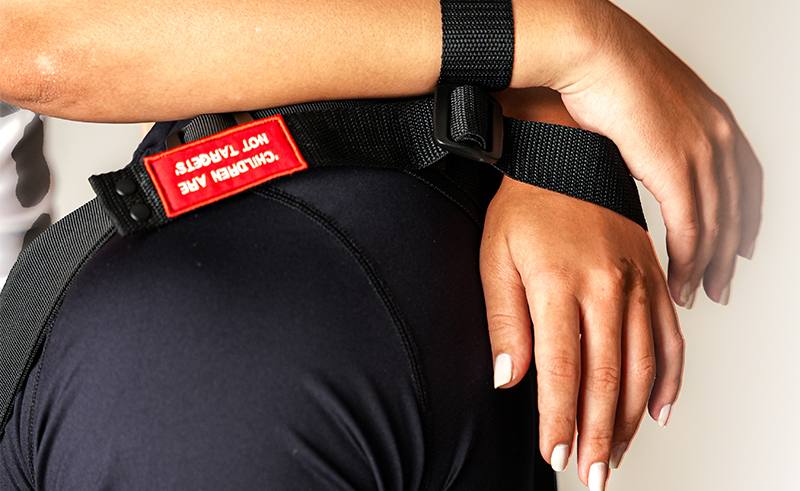
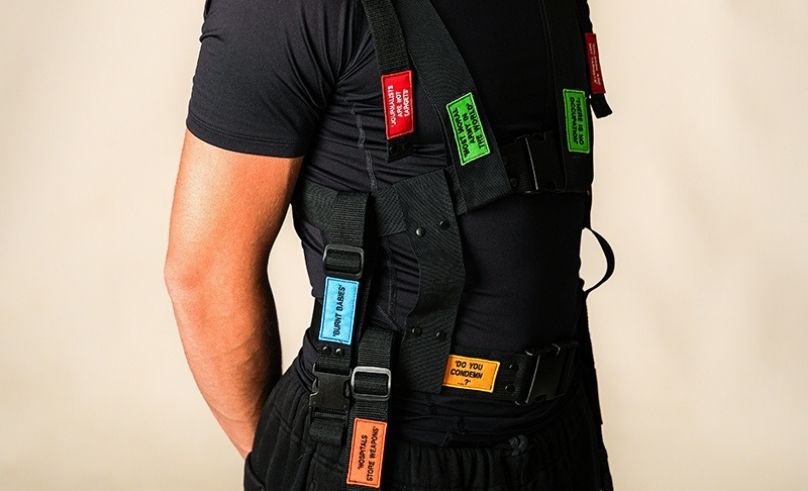
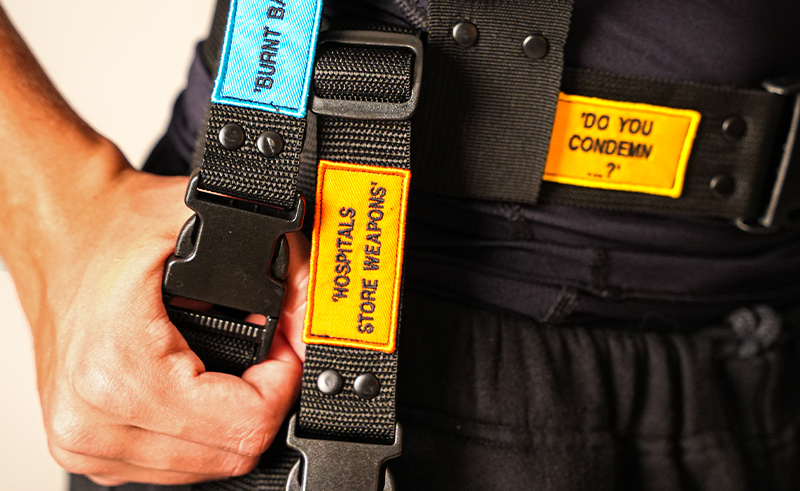
From this premise, Haber designed a “Human Harness”, a vest intended to aid in the carrying of injured or disabled survivors. While functional in nature, the harness also operates as a critical object, decorated with phrases commonly used in Western news outlets to justify conflict in the region, statements such as “Underground tunnels”, “Human Shields”, and “There is no occupation”. Haber explains: “I felt like satire was maybe the best way to fight against this propaganda.”
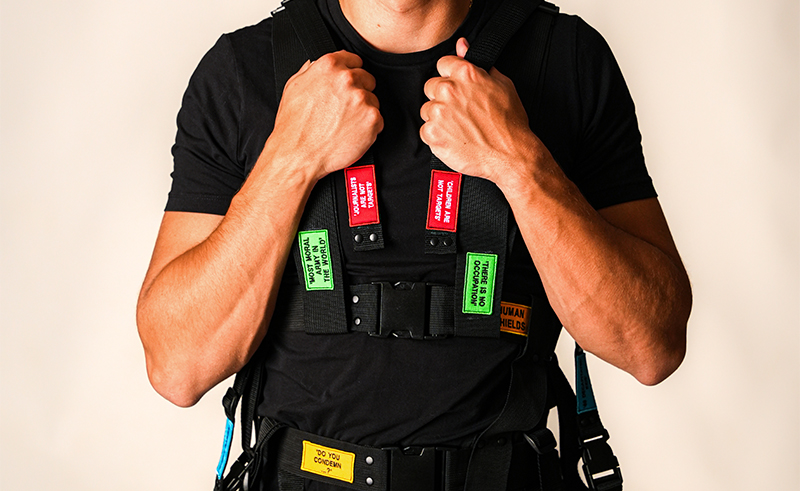
By borrowing the vocabulary of media and policy discourse and stitching it onto a body, Haber reframes abstraction while forcing viewers to confront how easily lives are transformed into terminology, and how design can reverse that process by returning language to embodiment.
The harness explores a clever double entendre of the expression “human shield”: on the one hand, protection can mean carrying the injured to safety; on the other hand, more disturbingly, using the wounded as a shield for survival. Through this tension, Haber challenges his audience to reconsider the role of design not only as a problem-solving tool but also as a medium capable of critique, resistance, and reflection.
Haber’s work sits within a wider generation of young Lebanese designers who are increasingly resistant to the idea of neutrality. Rather than treating conflict as a distant context, many of these students position it as an active condition that shapes materials, language, and form. Their projects operate in the space between urgency and authorship, where making becomes a way of responding to realities that are still unfolding.
- Previous Article HH Sheikha Bodour & Jaipur Rugs Unveil Desert-Inspired Carpets
- Next Article The Ancestral Resilience of Omar El Farouk’s Fayoum Home