

The Story Behind Banksy’s Hotel With "The Worst View in the World"
In 2005, a stranger asked a Bethlehem guide to show him around Palestine. He only found out months later he'd been hosting Banksy. Then, they built a hotel together.
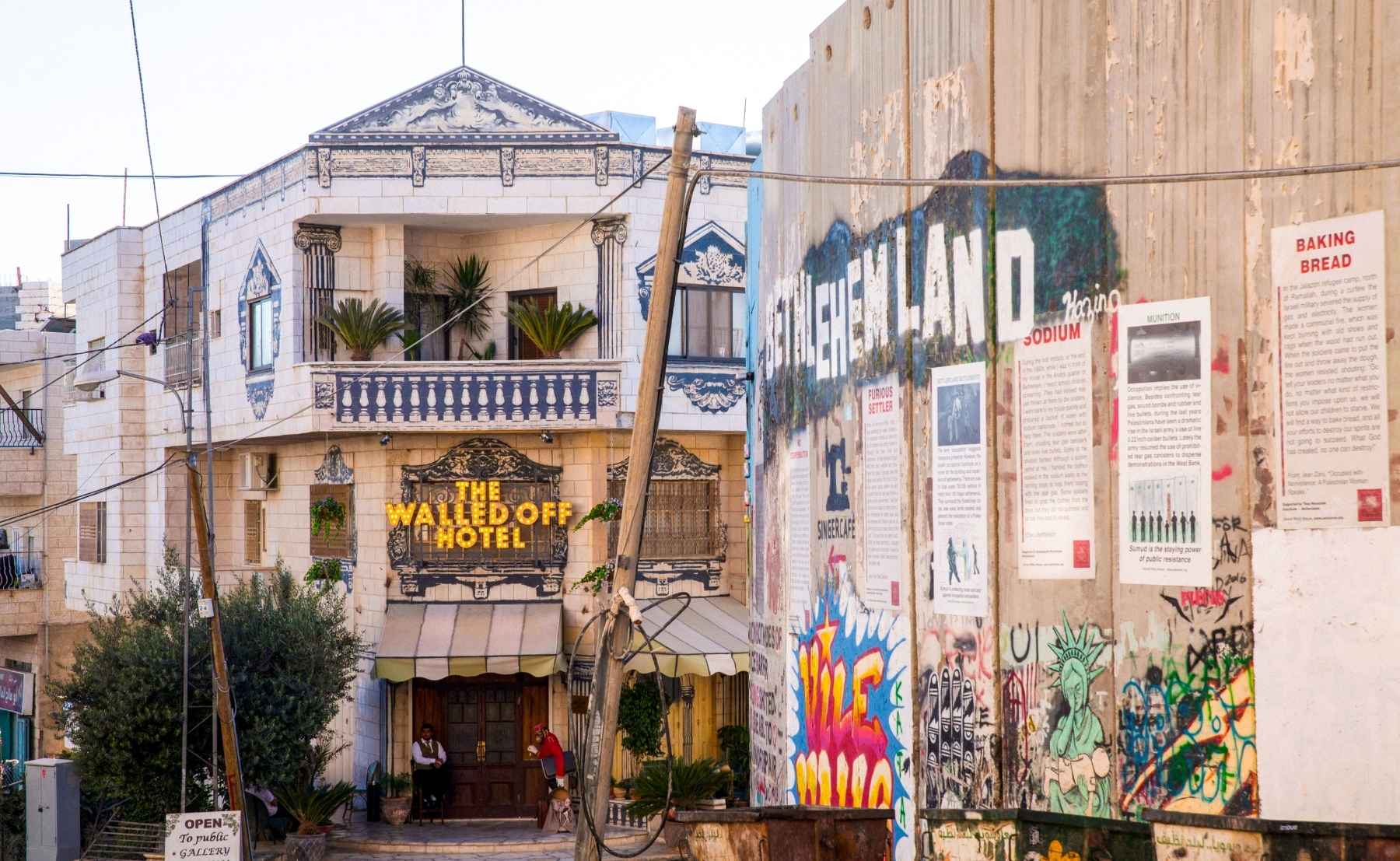
Anonymous British street artist Banksy famously described his hotel in Bethlehem, Palestine, as “the hotel with the worst view in the world.” Its name, ‘The Walled Off Hotel’, was partially a play on the luxury ‘Waldorf Hotel’, and mostly an acknowledgement of the apartheid wall it faces.
Banksy’s fascination with the formidable concrete structure that wraps around the occupied West Bank began in the early 2000s, shortly after Israel began its construction. Local guide Wisam Salsaa hosted Banksy on his first visit to Palestine in 2005. It was during the tail end of the Second Intifada (2000-2005) and 12 years before the two would open The Walled Off Hotel together, when Salsaa received his call.
He remembers exactly where he was standing when he answered the phone, in front of the Beit Sahour pharmacy. He remembers thinking it was an odd time to plan a trip to Palestine. “In 2005, we were still living in the Second Intifada,” Salsaa said. “Israeli tanks were still coming in and out of Bethlehem.”
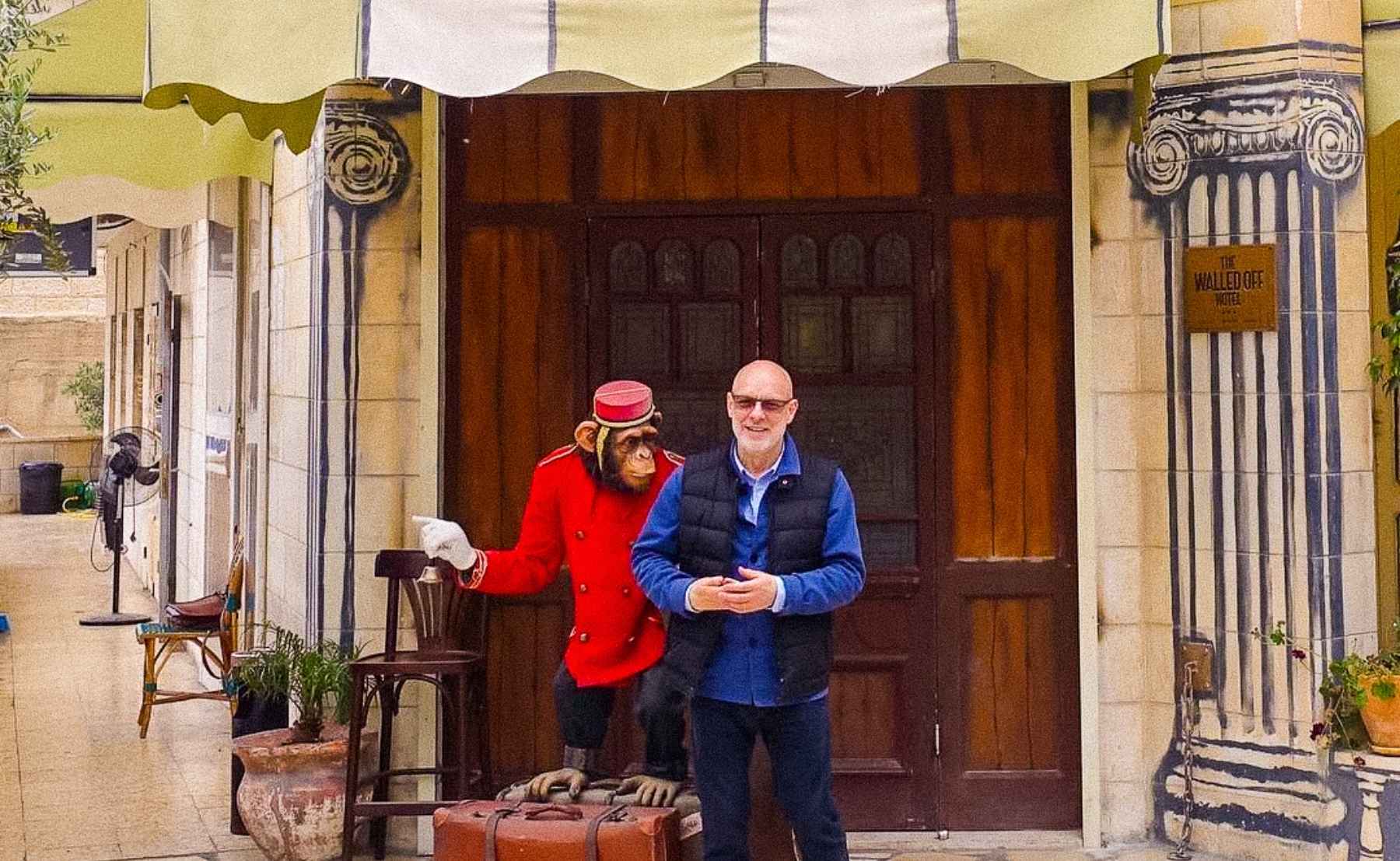
The voice on the other end of the line was a man looking for a tour guide for his first trip to the West Bank, but Salsaa wouldn’t know he was speaking with Banksy for months. A Bethlehem native, home to the birthplace of Jesus Christ, Salsaa had built a career as a tour guide in the Holy Land. He worked in ‘alternative tourism’ which encouraged people to visit Palestine and learn from Palestinians. He was one of the first Palestinian guides to obtain a license that allowed him to lead tours across Palestine and ‘Israel’.
“Banksy told me he wanted to come to Bethlehem to visit Palestine. He told me: ‘You have a new wall—I want to paint something on that wall’,” Salsaa recalled. “I did not take him seriously.”
All the hotels were closed, so Salsaa invited him to stay at his house instead. At any other time, he would have been too busy to host, but after years of a tourist drought, lockdown, and curfew, he was bubbling with excitement for a foreigner’s visit. “I was excited to see someone not Palestinian,” Salsaa said. Banksy arrived, and the two drove up and down the West Bank, to Ramallah, Abu Dis, Al-Eizariya and Hebron. Along the way, they stopped the car and Banksy beelined to the fresh concrete of the apartheid wall with cans of spray paint.
“I thought what he was doing was a bit strange—he didn’t tell me, and I did not ask,” Salsaa recalled. But he could tell the work was meaningful. “Months after he left, I saw a report on Al Jazeera talking about his graffiti. And that was the first time I heard the name ‘Banksy’.”
He painted some of his most famous pieces on that trip, each subverting Israeli occupation on a wall that had been declared illegal by the International Court of Justice just a year earlier—a girl being lifted into the air by balloons and children digging through a hole in the wall to see a tropical beach.
“Before he put a spray paint can in his hand, Banksy saw the reality in Palestine—spoke to people, walked in the streets. He also went to the other side of the wall,” Salsaa said. The artwork was a result of that on-the-ground research. “I believe that he conceived all of his ideas while he was there.”
Banksy returned a few times after that initial trip. In 2007, he opened an exhibition titled ‘Santa’s Ghetto’ in Bethlehem to which he contributed some of his own pieces and painted five more stencils on the apartheid wall. Bansky also travelled to Gaza in 2015 to draw attention to the aftermath of Israel’s Operation Protective Edge—a 50-day war on the besieged strip wherein they killed over 2,000 Palestinians. Bansky painted children swinging from an Israeli surveillance tower and a Greek goddess with her head in her hands. He allegedly entered through an illegal underground tunnel from Egypt.
“I approached him and I told him: ‘We have to do something permanent’,” Salsaa said. “I started to realise the power of art—what art can do, armies cannot.”'
Banksy agreed. They needed to create a project together to educate visitors on Palestine and the ongoing Israeli occupation. Salsaa found the location—a building only four metres away from the apartheid wall, abandoned by its inhabitants over a decade ago after Israel began its construction.
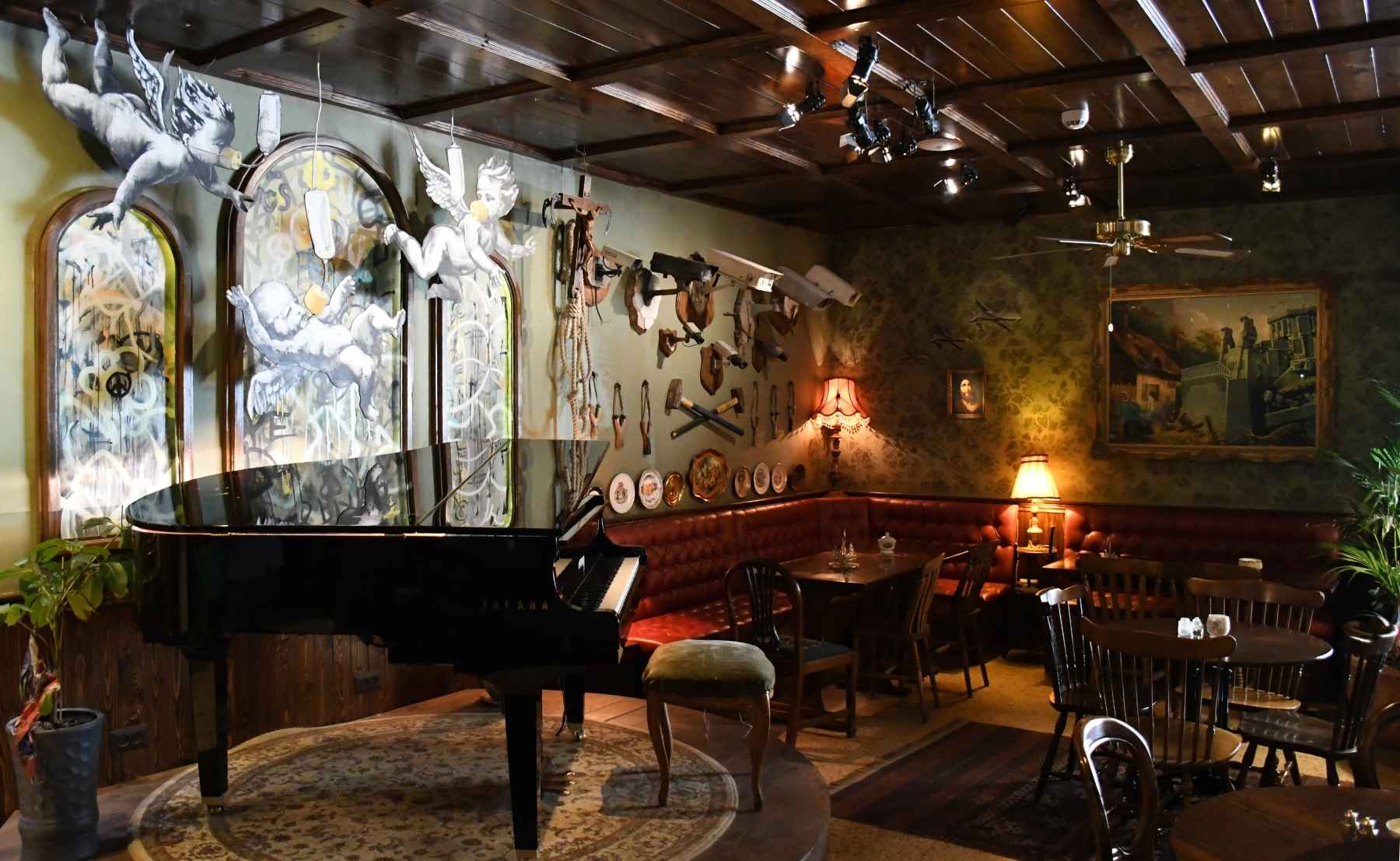
Salsaa’s wife, Rasha, joined the project as an architect. She converted Banksy’s ideas to a master plan and then into The Walled Off Hotel. Banksy visited after it opened in 2017 to add his artwork to the walls. But to keep his identity a secret, Salsaa closed the hotel down to the public, and he lived there alone for four weeks. “I called the hotel ‘the prison of Banksy’,” Salsaa laughed. He brought the artist food and water, “of course”, but it was too risky for him to leave. Salsaa and his wife were the only people who knew what Banksy really looked like.
The boutique hotel, however, is far from a prison. With only nine rooms total, the landmark doubles as an education centre, housing a museum on the history of Israeli occupation and one of the largest art galleries in the West Bank.
Almost every room showcases a floor-to-ceiling view of the graffitied apartheid wall. “The worse the view is, the more expensive the room becomes,” Salsaa said, returning to Banksy’s famous words.
One can choose from three different accommodation options, each decorated to remind you that you are inside occupied Palestine. The most expensive, the Presidential Suite, “is equipped with everything a corrupt head of state would need—a plunge bath able to accommodate up to four revellers, original artwork, library, home cinema, roof garden, tiki bar and a water feature made from a bullet riddled water tank,” the website reads. The Scenic room is cheaper, and Budget is the cheapest. The ladder is a six-bed, one-bathroom shared room designed to simulate Israeli military barracks, or even a prison cell.
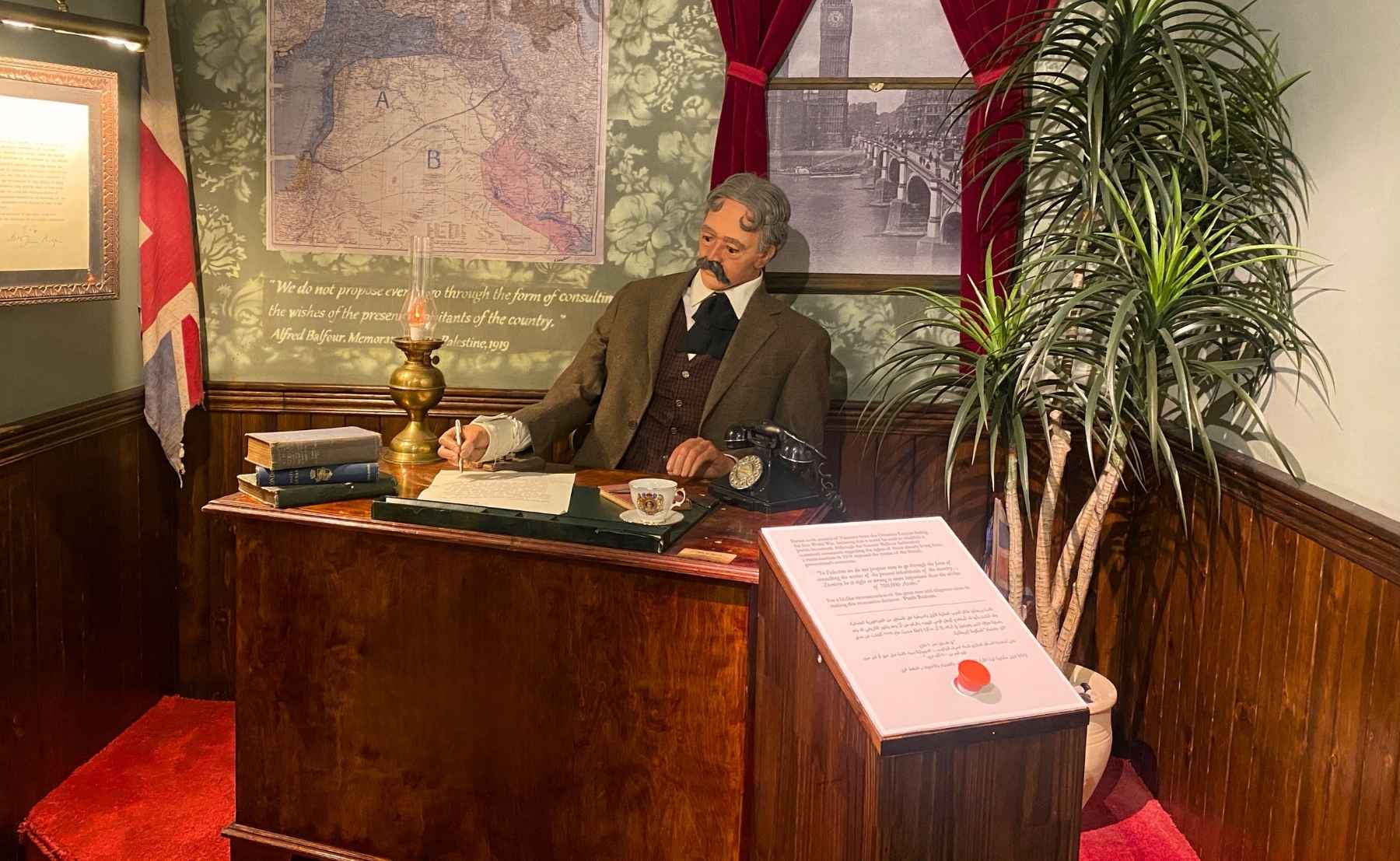
The museum on the lobby floor is where one can learn about why the wall next to them exists. It is part of the self-guided tour that includes the art gallery upstairs. The timeline begins with the 1917 Balfour Declaration, when the British government announced its support for the establishment of a Jewish state in Palestine. The Walled Off Hotel opened on the 100-year anniversary of its signing. “Banksy wanted to design the hotel in British colonial style,” Salsaa said. “He didn’t want the world to forget the role of England or the UK in what’s going on in Palestine today.”
The museum walks through an interactive history of the 1948 Nakba, the 1967 Naksa, and a timeline of resistance to Israeli occupation. In one of the last sections of the museum, a phone rings. One picks up, and an Israeli officer says, “You have 15 minutes to leave your house. Your house will be bombed.” It is a phone call many have taken in Gaza, and that many have missed.
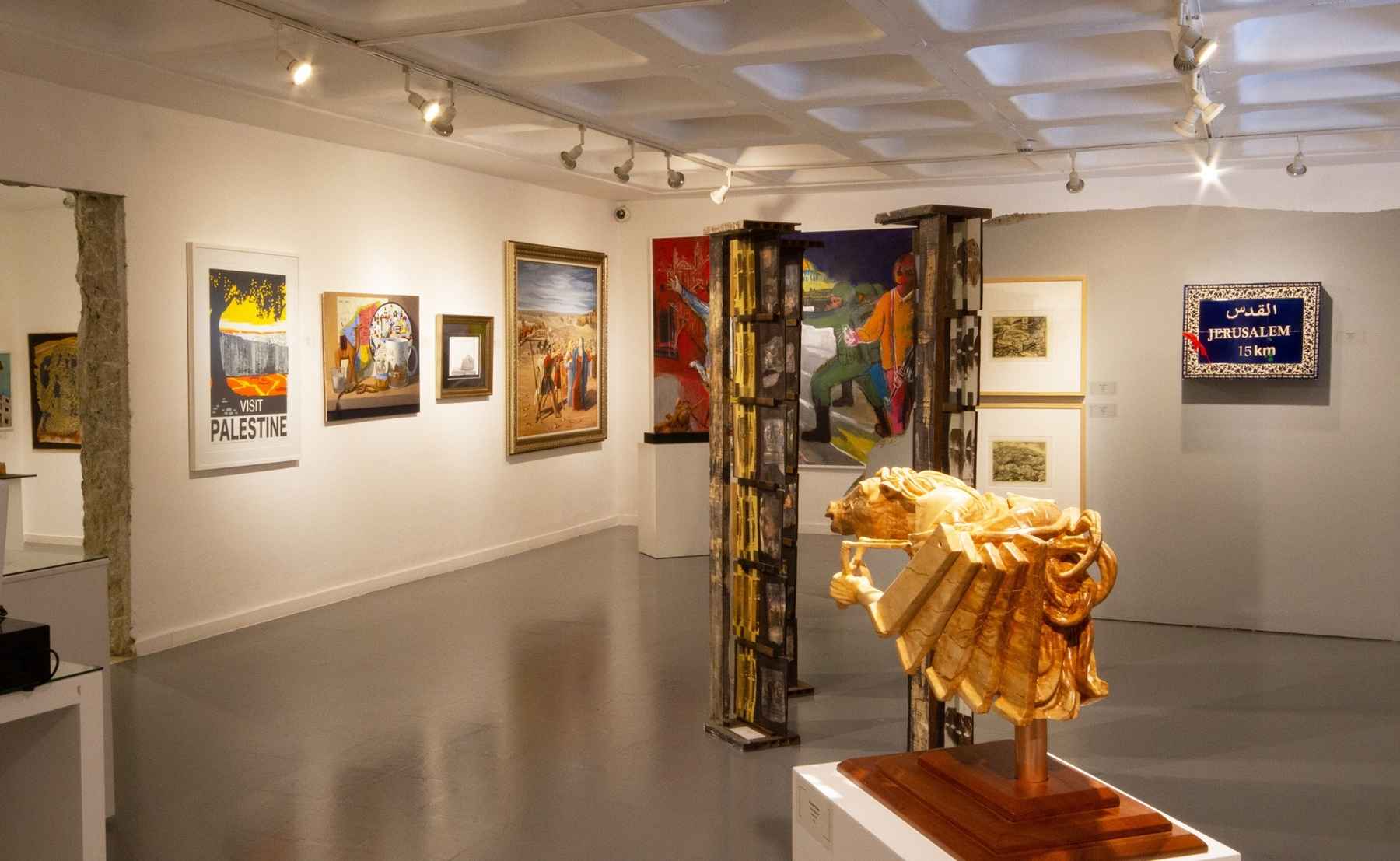
Out of the museum, and up the stairs, the art gallery houses established and emerging Palestinian artists. Names like Sliman Mansour, Khaled Hourani and Tayseer Barakat have exhibited their work throughout the years. Paintings are fastened onto a slice of wall in the middle of the room that looks as if it was broken off the one visible through the gallery’s window. The collective exhibition showcases the work of up to 50 artists at a time and rotates at least twice a year.
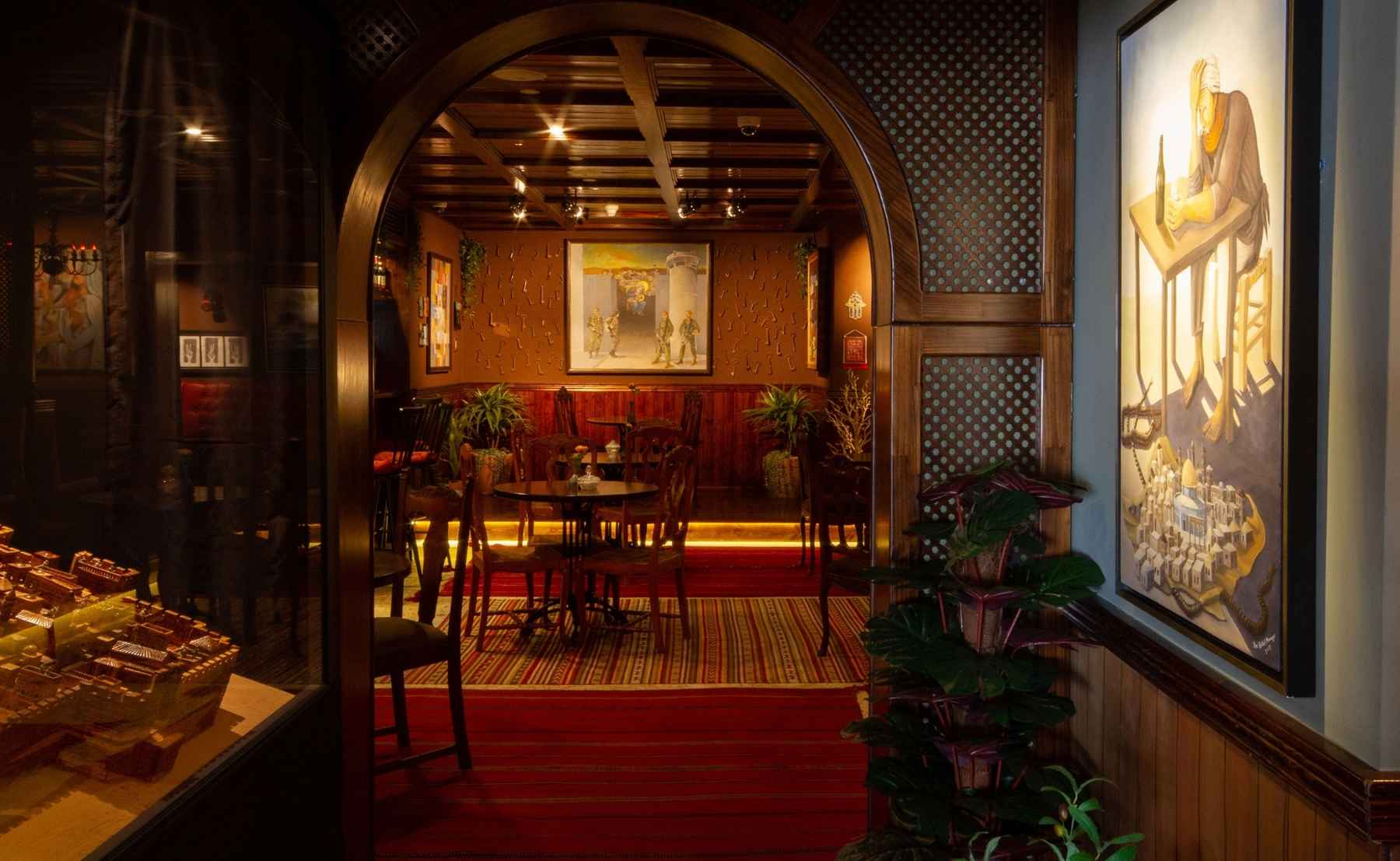
“Visitors can hear Palestinian voices through this art,” Salsaa said. “The art at our gallery is for sale, which is important support for Palestinian artists.” A smaller exhibition is dedicated specifically to young Palestinian artists from across Palestine—the West Bank, Gaza and inside ‘Israel’.
Since COVID, The Walled Off Hotel has been on a rollercoaster of global and geopolitical shutdown. They had only opened back up for a few months after the pandemic subsided when October 7th happened. But they’ve continued to keep their doors open as often as possible, even with dwindling tourism numbers. The Walled Off Hotel is a pillar of Bethlehem, but also a hub for international visitors, a function Salsaa sees as central to the Palestinian cause.
“We Palestinians need international support to get our freedom,” Salsaa said. “The hotel is about our image, how the media introduces us as Palestinians. It has a big job telling the Palestinian story properly, reaching and educating people through art.”